Get your brand inside AI answers, not just Google results
Answer Engine Optimization targets ChatGPT, Claude, Perplexity, and Google AI Overviews - the places your customers are now getting answers instead of clicking blue links.
When someone asks ChatGPT to recommend a tool or service in your category, your competitors are getting named and you are not. AEO is the work that fixes that: structured authority content, entity relationships, and citation-ready data that LLMs pull from and attribute.
4 platforms
ChatGPT, Perplexity, Claude & Gemini tracked
Cited
Goal: brand appears in category-query AI answers
Structured
Every content piece built for AI extractability
Monthly
Citation rate reported - not anecdotal
Trusted by founders & teams in

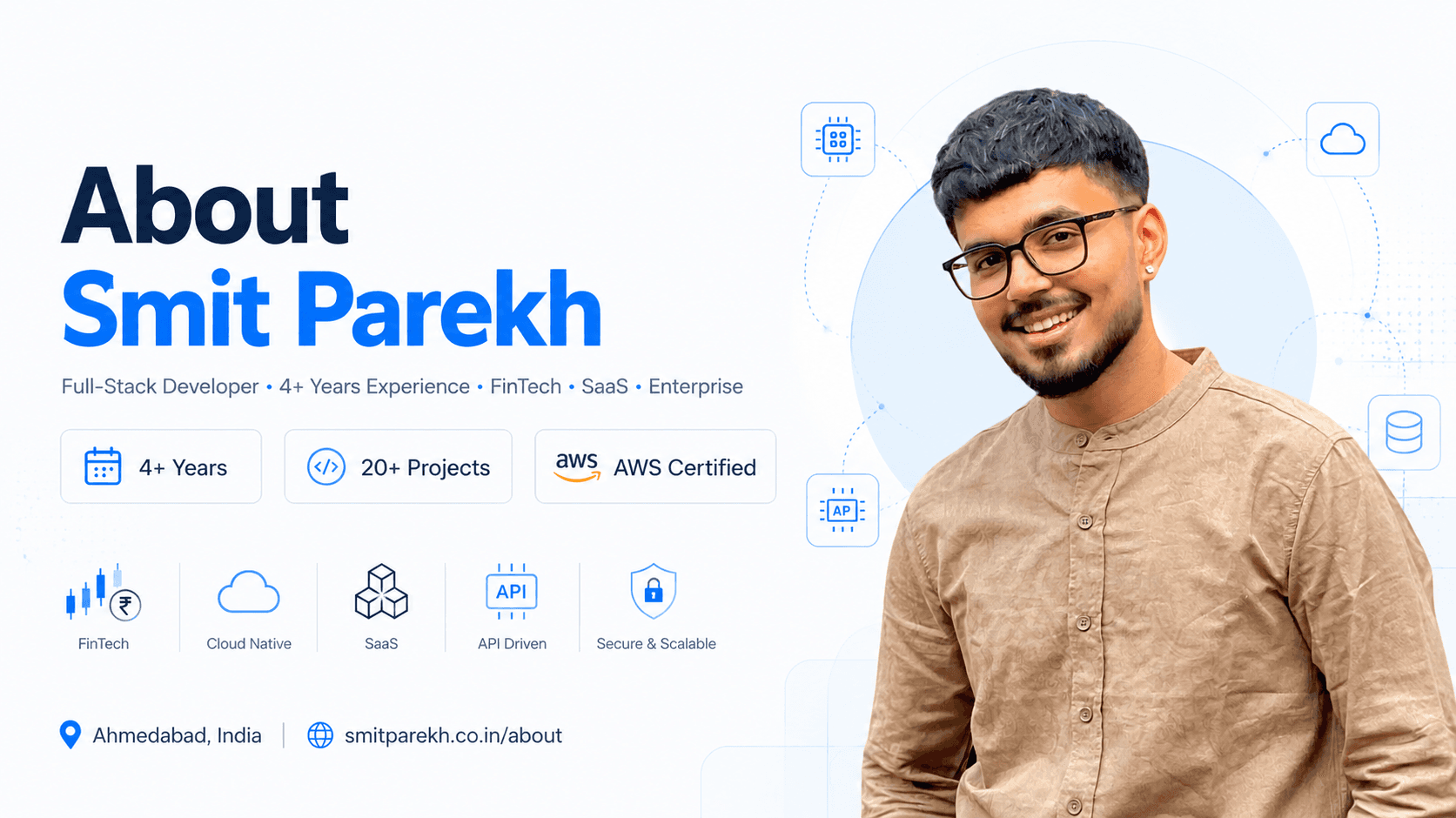
Smit Parekh
Full-Stack Developer
Gujarat, India · available worldwide
I'm the only person who touches your code. You talk directly to the senior developer writing every line - no account managers, no juniors, no handoffs. React, Next.js, Node.js, TypeScript and PostgreSQL, end to end.
- AWS Certified Solutions Architect
- 4+ years shipping production web apps
- 20+ live systems across FinTech, SaaS & AI
Everything included in every engagement
No upsells. No surprise change orders. One scope, one price.
AI visibility audit
Benchmark your current citation rate in ChatGPT, Perplexity, Claude, and Gemini for your priority queries. This is baseline - the number we grow from.
Question-and-answer content
Authoritative, directly-answerable content per target query. Structured to match how LLMs extract citations: clear claims, attributable sources, specific entities.
Entity & brand signal building
Wikipedia-equivalent entity coverage - consistent brand mentions across authoritative sources so LLMs recognize you as a real, trustworthy entity.
Schema & structured data for AI
FAQ, HowTo, Article, and Organization schema markup that makes your content machine-readable - the format AI engines prefer when extracting answers.
Topic authority content clusters
Comprehensive content on the questions in your space. LLMs cite what they trust, and trust is built by covering a topic thoroughly from multiple angles.
Citation tracking & reporting
Monthly tracking of citation frequency across AI platforms for your target queries. Measurable, not anecdotal.
Results that build trust
The numbers behind the work - measured on real production data, not demos.
4 platforms
ChatGPT, Perplexity, Claude & Gemini tracked
Cited
Goal: brand appears in category-query AI answers
Structured
Every content piece built for AI extractability
Monthly
Citation rate reported - not anecdotal
The tools I actually use in production
Modern, battle-tested, and chosen for fit - not hype.
Audit
- ChatGPT
- Perplexity
- Claude
- Gemini
Content
- Question research
- Entity mapping
- SurferSEO
- Clearscope
Schema
- JSON-LD
- FAQ schema
- HowTo schema
- Organization
Tracking
- Manual AI queries
- Perplexity API
- Brand monitoring
- Search Console
How we'll work together
Predictable, written-down, no surprises.
- 01
AI visibility baseline
Systematic prompting across ChatGPT, Perplexity, Claude, and Gemini for your top-20 category queries. Current citation rate documented.
- 02
Content gap & entity map
What questions LLMs answer about your category, which entities they cite, and where your brand is missing from the conversation.
- 03
Content & schema build
Q&A content, topic clusters, and schema markup targeting your gap queries - all structured for AI extractability.
- 04
Track & iterate
Monthly re-baseline across AI platforms. New queries added, underperforming content revised, citation trends reported.
AWS Certified
Solutions Architect
I'm Smit Parekh - a full-stack developer who writes every single line of your code
With 4+ years of experience shipping production systems for FinTech, SaaS, and AI startups, I work as a senior individual contributor - no juniors on your project, no account managers between you and the work. Every commit, every architecture decision, every deployment lands on my machine first.
I specialise in the TypeScript ecosystem - React & Next.js on the frontend, Node.js / NestJS on the backend, PostgreSQL for data, and AWS for infrastructure. I've built headless e-commerce stores, multi-tenant SaaS platforms, real-time dashboards, AI-powered tools, and performance-first marketing sites. The common thread: clean code, zero tech-debt handover docs, and measurable business results.
10+ production apps shipped
FinTech, SaaS, AI startups & e-commerce
95+ Lighthouse scores, guaranteed
Performance baked in from day one
AWS Certified Solutions Architect
Infrastructure decisions you can trust
Direct, async-first communication
You talk to who writes every line of code
My daily stack
Pricing that matches the work
Starting prices. Final quote in writing after a 30-minute scoping call.
AEO Audit
Baseline + action plan
$600starting
- AI citation baseline across 4 platforms
- Gap analysis vs competitors
- Prioritised content plan
AEO Sprint
6-week citation push
$3,000starting
- Audit + 10 Q&A content pieces
- Entity & schema implementation
- Monthly citation tracking
Retainer
Ongoing AI search growth
$1,600/mostarting
- 4 content pieces/mo
- Monthly citation report
- Schema + entity upkeep
Me vs. an agency vs. hiring in-house
Three ways to get this built. Here's the honest comparison.
Best value Solo Dev (me) $80-$120 /hr or fixed | Agency $150-$300 /hr blended | In-house hire $80-$120K /yr + benefits | |
|---|---|---|---|
| Start date | 1-2 weeks from quote | 4-8 weeks onboarding | 8-16 weeks to hire |
| Who writes the code | Senior dev - every single line | Junior assigned to your account | Whoever you manage to hire |
| Communication | Direct - you talk to who codes | Via account manager first | Direct, but management overhead |
| Flexibility | Scale up or down any time | Locked to contract length | Fixed headcount, hard to change |
| Code ownership | 100% yours, full handover docs | Depends on contract terms | Yours, but bus factor risk |
| Risk | Weekly demos, fixed scope | Scope creep & handoff gaps | Wrong hire = months lost |
Questions I get asked first
Is AEO different from traditional SEO?+
Yes. Traditional SEO targets Google's 10 blue links - ranking factors are page speed, backlinks, and keyword relevance. AEO targets AI-generated answers - factors are content authority, entity recognition, and structured extractability. You need both, but they require different work.
Can you guarantee my brand gets cited by ChatGPT?+
No guarantee - LLMs are probabilistic and their citation behavior changes as they're updated. What I can guarantee is a systematic program that builds the content and entity signals that increase citation probability, and monthly tracking that shows whether it's working.
How is AEO different from GEO?+
AEO is broader - it covers all AI answer engines (ChatGPT, Perplexity, Claude, Gemini). GEO specifically targets Google's AI Overviews (the AI-generated answer at the top of Google results). Both overlap significantly but GEO work is tied to Google's specific algorithms and your existing GSC performance.
How quickly will I see results?+
Citation frequency changes happen over 2-4 months as new content gets indexed and picked up by LLM training or retrieval systems. Perplexity-style retrieval engines pick up new content faster than model-training-based citations.
Let's scope your project
Tell me what you're building. I'll reply with a written estimate within 24 hours - no sales call required.
Related services
Often paired with aeo optimization.
GEO Optimization
Generative Engine Optimization targets Google AI Overviews, Bing Copilot, and AI-generated search summaries - the new zero-click layer that appears before organic results.
Content SEO
Keyword research, intent mapping, and genuinely useful long-form content - written by someone who understands your product and the search engines (classic and AI) reading it.
SEO Services
On-page, technical, and content SEO - combined into one engagement, run by a developer who can actually fix the rendering bugs your audit will surface.
Technical SEO
Core Web Vitals, schema, indexation, and JavaScript-rendering work - by someone who reads the Next.js source, not just the SEO tool report.