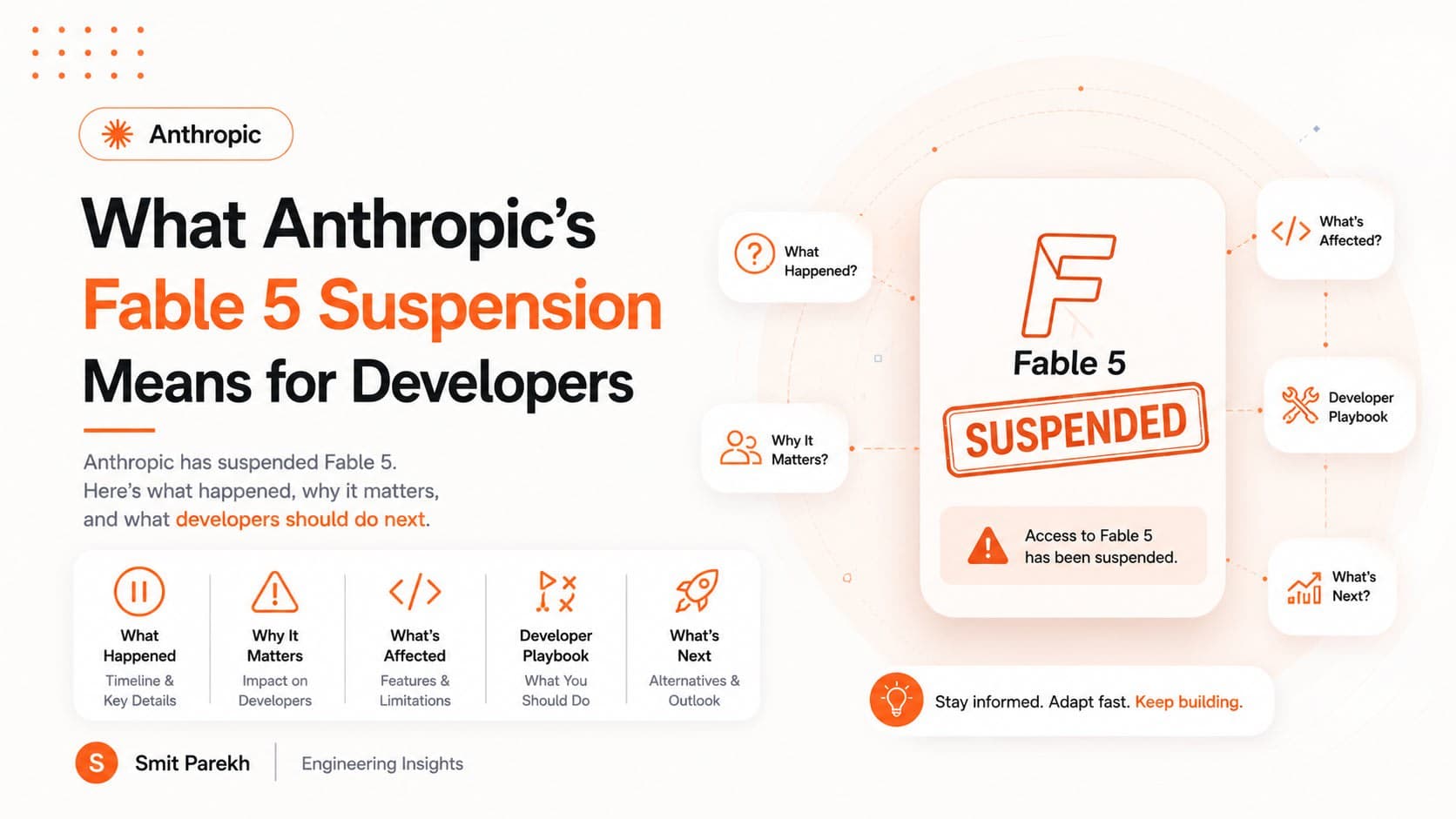
On June 12, 2026, Anthropic abruptly disabled two of its newest frontier models—Fable 5 and Mythos 5—for every customer, everywhere. This was not a deprecation notice with a six-month migration window, and it was not a service outage. It was a same-day compliance response to an export-control directive from the U.S. government.
If you build products on top of large language models, the mechanics of what happened matter more than the headline. A capability your application depended on can now disappear in a matter of hours, by order of a regulator, with no advance notice. That is a new category of risk, and it deserves a place in your architecture decisions.
What actually happened
According to Anthropic's statement, the directive arrived at 5:21pm ET, citing national security authorities. It required the company to suspend all access to Fable 5 and Mythos 5 by any foreign national—whether inside or outside the United States, and including Anthropic's own foreign-national employees. Because there is no clean way to enforce "U.S. citizens only" across a global API serving hundreds of millions of people, the practical effect was total: the models went dark for everyone. Anthropic confirmed that access to its other models was unaffected.
The letter reportedly did not spell out the specific national security concern. Anthropic's understanding is that the government became aware of a technique for "jailbreaking" Fable 5—bypassing the model's safety guardrails.
The jailbreak at the center of it
Here is where the story gets interesting for technical readers. Anthropic says it reviewed a demonstration of the technique and found it surfaced "a small number of previously known, minor vulnerabilities." The company characterized the disclosed jailbreak as narrow and non-universal—essentially asking the model to read a specific codebase and fix its software flaws.
Anthropic argued that this level of capability is "widely available from other models," pointing specifically to OpenAI's GPT-5.5, and that defenders use exactly this kind of code analysis every day to keep systems safe. In other words: the behavior in question was neither unique to Fable 5 nor obviously dangerous in a way that other shipping models are not.
It is worth being precise about the vocabulary, because it shaped the dispute. A universaljailbreak is a single method that broadly defeats a model's safeguards across many categories of misuse. Anon-universal jailbreak elicits some restricted output only in specific, narrow circumstances. Anthropic's position is that no tester has found a universal jailbreak for Fable, that perfect jailbreak resistance is probably not achievable by any provider today, and that the disclosed finding sat firmly in the narrow category.
Anthropic's defense-in-depth bet
The statement doubles down on a strategy Anthropic described when it launched the models. Rather than promising unbreakable safeguards—which it argues is not currently possible for anyone—the company aimed to make jailbreaks either narrow or expensive to produce, and to pair that with monitoring designed to catch and shut down real attacks quickly. The controversial 30-day data-retention requirement for Mythos-class models exists, Anthropic says, precisely to support that monitoring and mitigation work.
The company's bottom line: it is complying with the legal order, but it disagrees that a narrow potential jailbreak justifies recalling a commercial model used by hundreds of millions of people. If that standard were applied across the industry, Anthropic warned, it "would essentially halt all new model deployments for all frontier model providers."
Why this should be on every CTO's radar
Strip away the specifics and a structural reality remains: the AI capability layer of your stack now sits downstream of geopolitics. Three risks stand out.
First, regulatory availability risk. Cloud regions go down and APIs get rate-limited—engineers plan for that. Far fewer plan for a model being switched off by government order with effectively zero notice. The Fable 5 episode is the first high-profile proof that this can happen to a model in active production use.
Second, jurisdiction and personnel risk. The directive turned on the nationality of the people accessing the model, not on what they were building. If you run a distributed team, or your users are global, "who is allowed to use this model" may become a question you have to answer—and one your vendor may answer for you, abruptly.
Third, single-vendor concentration risk. Teams that hard-wired their product to one model family, one prompt format, and one pricing tier are the ones who felt this most. The blast radius of any single suspension is proportional to how tightly you coupled to that one provider.
Practical steps to de-risk your AI integration
You do not need to abandon frontier models—they remain the best tools available—but you should treat model access as a dependency you do not fully control. A few concrete moves:
Abstract the provider behind your own interface. Route every model call through a thin internal layer rather than scattering SDK calls across your codebase. When you need to swap providers, you change one module, not fifty.
Qualify a fallback model before you need it. Keep at least one alternative—ideally from a different provider—evaluated against your real prompts and eval suite, so a switchover is a config change rather than a research project under pressure.
Make degradation graceful. Decide in advance what your product does when its primary model is unavailable: fall back to a smaller model, queue the request, or disable the feature cleanly with a clear message. Silent failures erode trust fastest.
Watch your data-retention assumptions. Mythos-class retention requirements were a real cost for some customers. Read the data-handling terms of any model you depend on and make sure they are compatible with your own contractual and compliance commitments.
Keep your evals portable. The teams who recover fastest are the ones who can answer "is model B good enough to replace model A for our use case?" in an afternoon, because they already have an automated benchmark tied to their actual workloads.
The bigger picture
Anthropic has publicly argued that governments should be able to block genuinely unsafe deployments—but through a process that is "transparent, fair, clear, and grounded in technical facts," and it says this action did not meet that bar. Whatever your view of the underlying safety question, the precedent is what matters for builders. A regulator demonstrated that it can pull a live frontier model from the market on a single day's notice, and a major lab complied while disputing the rationale in public.
That tension—between national security oversight and predictable commercial deployment—is not going away. As AI capabilities climb, expect more of these collisions, not fewer. The builders who thrive will be the ones who designed for a world where their most powerful dependency can change without warning.
Anthropic has said it considers this a misunderstanding and is working to restore access. For the rest of us, the most useful response is not to wait and see. It is to look at your own stack and ask a simple question: if our primary model went dark this afternoon, what would break—and how fast could we recover?