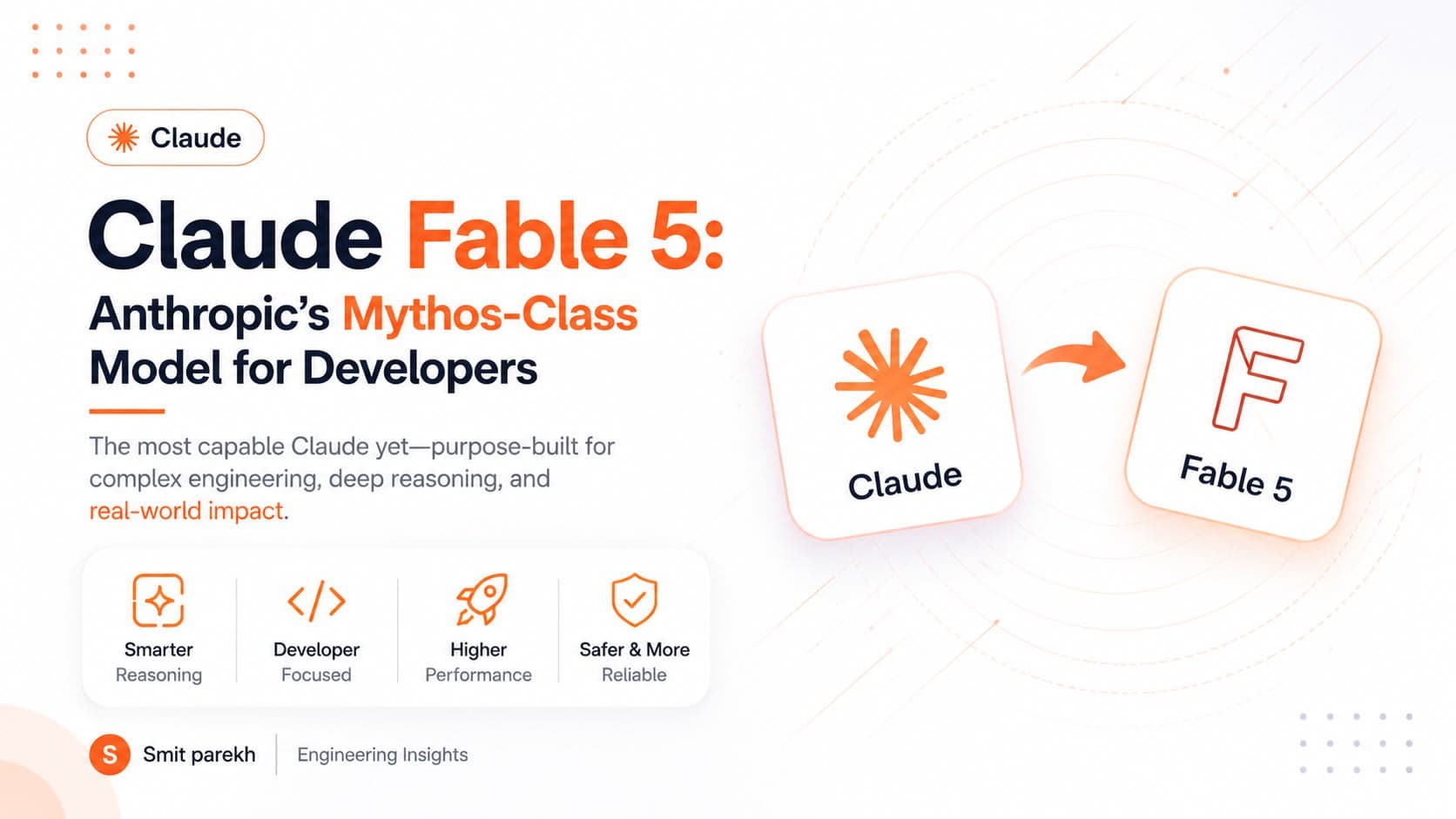
Claude Fable 5 is Anthropic's most capable generally available AI model, released on June 9, 2026. It is the first model in the new Mythos-class tier, which sits above Claude Opus in capability. Fable 5 outperforms Claude Opus 4.8 by more than 10 percent on some benchmarks, supports a 1 million token context window by default, generates up to 128k output tokens per request, and is priced at $10 per million input tokens and $50 per million output tokens. The headline story is simple: the model Anthropic once said was too dangerous for public release is now available to everyone, wrapped in a new kind of safety architecture.
If you build with LLMs, integrate AI into products, or advise teams on model selection, this release changes the calculus. Here is everything you need to know.
What Is Claude Fable 5?
Claude Fable 5 is the public version of Anthropic's Mythos-class model family. Back in April 2025, Anthropic introduced Claude Mythos Preview through a restricted program called Project Glasswing, limited to cyber defenders, critical infrastructure providers, and major software maintainers. The company held it back from general release because of its advanced cybersecurity capabilities, which it judged too risky to put in everyone's hands.
Fable 5 solves that problem with a different approach: instead of limiting who gets access, Anthropic limits what the model will engage with. The underlying model is the same one powering Claude Mythos 5. The difference is a layer of conservative safeguards that activate in specific high-risk domains.
The result is a model that delivers state-of-the-art performance across software engineering, knowledge work, vision, scientific research, and long-horizon agentic tasks, while staying within guardrails that made a broad release possible in the first place.
How Is Fable 5 Different From Mythos 5?
The two models share the same underlying weights and the same capabilities. The distinction is entirely about safeguards and availability.
| Claude Fable 5 | Claude Mythos 5 | |
|---|---|---|
| Availability | Generally available | Approved organizations only |
| Safeguards | Active in high-risk domains | Lifted in some areas |
| Access path | Claude API, claude.ai, Bedrock, Vertex AI, Microsoft Foundry | Project Glasswing |
| Pricing | $10 / $50 per M tokens | $10 / $50 per M tokens |
| Context window | 1M tokens | 1M tokens |
Mythos 5 is deployed through Project Glasswing in collaboration with approved cybersecurity partners and select biology researchers. Unless you work for one of those organizations, Fable 5 is the model you will actually use.
What Do the Safety Guardrails Actually Do?
This is the most architecturally interesting part of the release. When a conversation touches a restricted high-risk area, primarily cybersecurity, chemistry, and biology, the system does not simply refuse. Instead, it routes the query to Claude Opus 4.8, which answers in place of Fable 5.
Anthropic has tuned this routing conservatively, which means it may trigger more often than strictly necessary, but the company expects safeguards to activate in fewer than 5 percent of sessions on average. For the vast majority of development work, writing code, debugging, architecture planning, content generation, data analysis, you will never notice the routing layer exists.
For developers, the practical takeaway is this: if your product operates in security tooling, penetration testing, or life sciences, test your prompts against Fable 5 early. You may find some workflows silently served by Opus 4.8 instead, with different output characteristics.
How Much Does Claude Fable 5 Cost?
Fable 5 is priced at $10 per million input tokens and $50 per million output tokens. That makes it the most expensive major model on the market, roughly double the cost of Opus-tier models, though it is less than half the price of the original Claude Mythos Preview.
Subscription access has a twist. From June 9 through June 22, 2026, Fable 5 is included at no extra cost on Pro, Max, Team, and seat-based Enterprise plans. On June 23, Anthropic removes it from those plans, and continued use requires usage credits. The company plans to restore standard subscription access when capacity allows.
If you want to evaluate Fable 5 without committing API spend, this two-week window is the time to do it.
What Does Fable 5 Mean for Working Developers?
Three things stand out from early reports and Anthropic's own benchmarks.
Long-horizon autonomy. Fable 5 can work autonomously for longer than any prior Claude model, and it outperforms Opus models specifically on longer, more complex tasks. This matters most for agentic workflows: large refactors, multi-step migrations, and tasks that previously required a human to re-prompt and re-orient the model every few minutes.
Real-world migration evidence. Stripe reported that Fable 5 compressed months of engineering work into days, completing a large Ruby codebase migration that would have taken a team more than two months. One data point is not a trend, but it is the kind of data point that gets CTOs to approve evaluation budgets.
A 1M token context window by default. Combined with 128k output tokens per request, this changes how you architect AI features. Whole-repository context, full documentation sets, and long multi-document analysis become single-request operations rather than retrieval pipelines. RAG is not dead, but the threshold where you need it just moved significantly.
Should You Switch to Fable 5? A Decision Framework
Use this framework to decide where Fable 5 fits in your stack.
Choose Fable 5 when:
- Your tasks are long-horizon and agentic: large migrations, multi-file refactors, autonomous coding sessions
- You need massive context: monorepo analysis, legal or research document sets, extended conversations
- Output quality directly drives revenue and a 2x token cost is acceptable
- You are evaluating frontier capability for a product roadmap decision
Stay on Opus 4.8 or Sonnet 4.6 when:
- Your workload is high-volume and cost-sensitive: chatbots, classification, summarization at scale
- Tasks are short and well-bounded, where the capability gap will not show
- Your product operates heavily in domains where Fable 5's safeguards route to Opus 4.8 anyway
- Latency matters more than peak intelligence
The honest answer for most production systems is a tiered approach: route the hardest 10 percent of tasks to Fable 5 and keep everything else on cheaper models. The API makes this trivial since the model string is just claude-fable-5.
How to Start Building With Claude Fable 5
Getting started takes minutes if you already use the Claude API:
const response = await fetch("https://api.anthropic.com/v1/messages", {
  method: "POST",
  headers: {
    "Content-Type": "application/json",
    "x-api-key": process.env.ANTHROPIC_API_KEY,
    "anthropic-version": "2023-06-01"
  },
  body: JSON.stringify({
    model: "claude-fable-5",
    max_tokens: 4096,
    messages: [
      { role: "user", content: "Refactor this service to use dependency injection" }
    ]
  })
});
Fable 5 is generally available on the Claude API, Claude Platform on AWS, Amazon Bedrock, Vertex AI, and Microsoft Foundry, so it slots into existing cloud deployments without new vendor relationships. Note that Fable 5 is designated a Covered Model, which carries 30-day data retention and is not available under zero data retention agreements. If your compliance posture requires ZDR, that is a real constraint to flag before adoption.
A sensible evaluation plan for the free window: pick one genuinely hard task from your backlog, something Opus 4.8 struggled with, run it through Fable 5 in Claude Code or the API, and measure the delta yourself. Benchmarks are marketing; your codebase is the truth.
The Bottom Line
Claude Fable 5 marks the moment frontier AI capability and public availability stopped being a trade-off and became an engineering problem. Anthropic's answer, same model, dynamic safeguards, tiered access, will likely become the template other labs follow. For developers, the immediate move is practical: you have until June 22 to test the most capable publicly available model in the world at no extra cost on a paid plan. Use the window, measure the results on your own workloads, and decide with data.