Developing AI-powered products demands specialized expertise, often leaving founders and CTOs with a critical decision: should they engage a full-stack development agency or bring in a senior full-stack consultant? This choice significantly impacts project velocity, cost-effectiveness, and the ultimate return on investment (ROI). I've seen firsthand how the wrong decision here can lead to budget overruns and missed market opportunities, especially when integrating complex AI/LLM features.
TL;DR
- Senior Consultant: Offers deep, focused expertise, often more cost-effective for specific, high-impact AI features.
- Development Agency: Provides broader resources and project management, potentially higher overhead for niche AI tasks.
- ROI Focus: Consultants excel in optimizing specific engineering challenges and knowledge transfer, boosting long-term team capability.
- Flexibility: Consultants adapt quickly to evolving AI requirements; agencies might have more rigid processes.
- Direct Impact: A consultant integrates directly, driving technical decisions and implementation with minimal layers.
The Consultant Advantage: Deep Expertise, Direct Impact
Hiring a senior full-stack consultant for your AI product development means bringing in an individual with extensive hands-on experience in areas like Next.js, React, Node.js, TypeScript, and crucially, AI/LLM integration. This isn't just about writing code; it's about architectural decisions, performance optimization, and navigating the nuances of LLM APIs, fine-tuning, and prompt engineering.
I've found that a seasoned consultant often acts as an extension of your internal team, providing not just output but also mentorship and knowledge transfer. For instance, when integrating a complex RAG (Retrieval Augmented Generation) pipeline, a consultant can quickly architect the solution, implement the necessary backend services (Node.js/Python), and connect it to a performant Next.js frontend, all while guiding your existing engineers.
Specialized Skill Set & Efficiency
Consultants specializing in AI product development bring a focused skill set. They're not learning on your dime; they've already solved similar problems. This translates directly into efficiency. Consider a scenario where you need to build a custom AI agent that interacts with your internal APIs. A consultant might:
- Rapidly prototype the agent's core logic using a framework like LangChain or LlamaIndex.
- Design and implement secure API integrations in Node.js.
- Develop a resilient data ingestion pipeline for context, potentially leveraging services like Pinecone or Weaviate.
- Optimize prompt strategies for cost and performance.
This focused approach minimizes scope creep and accelerates time-to-market. The consultant's daily rate might seem higher than an agency's blended rate, but the sheer speed and quality of delivery often lead to a lower overall project cost and a faster ROI.
Cost-Effectiveness and ROI
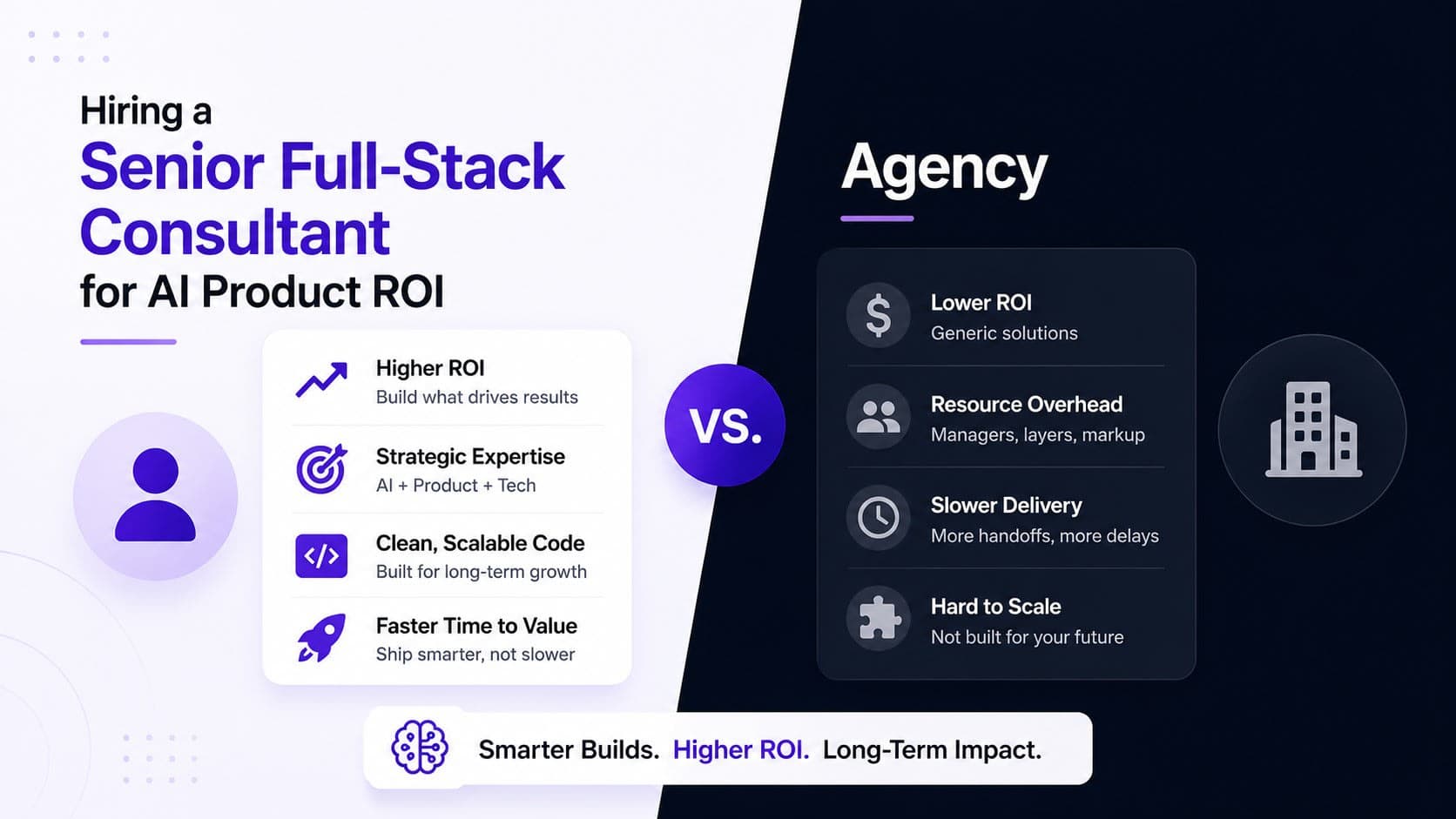
Let's break down the financial aspect. An agency typically charges a project fee or a higher hourly rate to cover overheads like sales, project management, and a bench of developers. While they offer a complete package, you might pay for resources you don't fully utilize, especially for highly specialized tasks like AI integration.
A senior full-stack consultant, on the other hand, operates with lower overhead. Their rate reflects their direct, highly valuable contribution. For a critical AI feature that could unlock significant business value (e.g., automated customer support, personalized content generation), the consultant's ability to deliver quickly and effectively means a faster realization of that value.
Consider a project requiring 3 months of focused AI integration. An agency might quote $150,000 - $300,000 USD, while a top-tier consultant might charge $25,000 - $40,000 USD per month, totaling $75,000 - $120,000 USD. The consultant's price point is often more competitive for the specific expertise required, resulting in a clearer ROI path.
| Feature / Aspect | Senior Consultant | Development Agency |
|---|---|---|
| Expertise Depth | Very deep, specialized (e.g., AI/LLM, Next.js, DevOps) | Broad, covers many tech stacks, potentially less niche depth |
| Cost Structure | Hourly/Daily Rate (e.g., $150-300 USD/hour) | Project-based/Retainer (higher overhead, blended rates) |
| Project Focus | Specific features, architecture, problem-solving | Full lifecycle, multiple workstreams, PM |
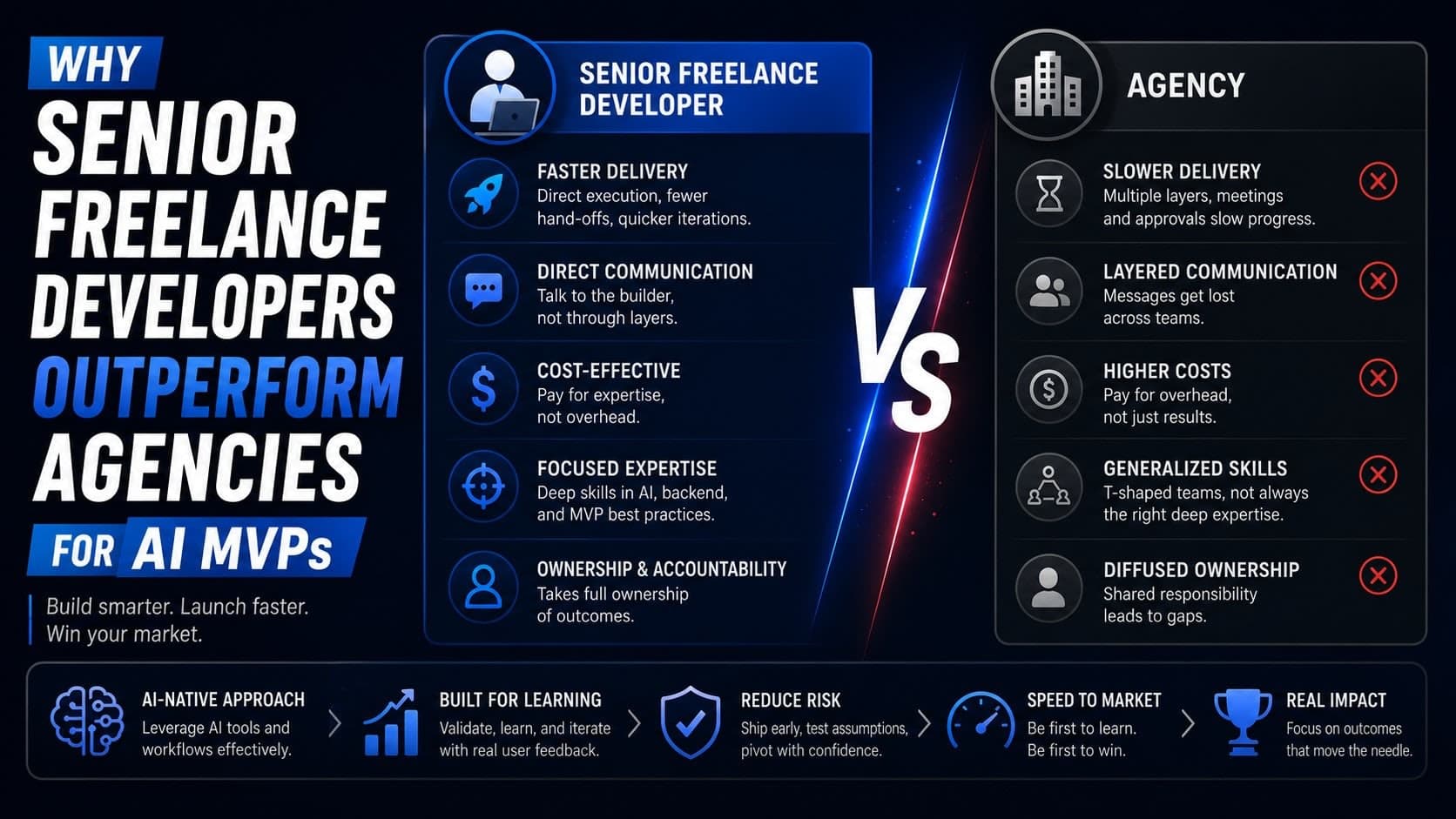
| Speed & Agility | High, minimal bureaucracy, direct communication | Moderate, depends on internal processes, multiple layers |
| Knowledge Transfer | High, embedded with team, direct mentorship | Moderate, often through documentation or formal handovers |
| Typical Engagement | Short-to-medium term, critical path items | Medium-to-long term, comprehensive builds |
| Suitable For | AI MVP, complex integrations, performance bottlenecks | Large-scale product builds, ongoing maintenance |
The Agency Approach: Scale and Managed Processes
Agencies shine when you need a full team, managed processes, and don't have the internal capacity for project management. They can staff multiple roles (PMs, designers, frontend, backend, QA) and manage the entire development lifecycle. If your AI product requires significant UI/UX design, multiple backend services, and extensive QA, an agency can be a viable option.
However, for highly specialized tasks like optimizing a large language model's inference pipeline or architecting a robust RAG system, an agency might either outsource the AI component (adding another layer of cost and communication) or have their generalist engineers learn on the job, which can be slow and error-prone.
Overhead and Communication Layers
Working with an agency often introduces more communication layers. You'll typically interact with an account manager or project manager, who then relays information to the technical team. This can sometimes dilute technical nuances, especially in the fast-evolving AI landscape. A consultant, by contrast, provides direct access to the engineer doing the work, fostering quicker feedback loops and more precise problem-solving.
Example: Building an AI-Powered Content Generator
Imagine you're building an AI-powered content generation tool using Next.js for the frontend, Node.js for the API, and integrating with OpenAI's GPT models. Your goal is to generate high-quality blog posts based on user prompts.
With a senior full-stack consultant, the process might look like this:
- Week 1-2: Set up Next.js project, implement core UI, establish Node.js API with secure routes for AI calls. Integrate
openailibrary. - Week 3-4: Develop prompt engineering strategies, implement streaming API responses for better UX, add caching layers.
- Week 5-6: Refine output quality, add user authentication, deploy to Vercel/AWS. Focus on performance and cost optimization of LLM calls.
Here's a simplified Node.js API route that a consultant might implement for streaming AI responses:
// src/pages/api/generate-content.ts (Next.js API route)
import type { NextApiRequest, NextApiResponse } from 'next';
import OpenAI from 'openai';

const openai = new OpenAI({
  apiKey: process.env.OPENAI_API_KEY,
});

export default async function handler(req: NextApiRequest, res: NextApiResponse) {
  if (req.method !== 'POST') {
    return res.status(405).json({ error: 'Method Not Allowed' });
  }

  const { prompt } = req.body;

  if (!prompt) {
    return res.status(400).json({ error: 'Prompt is required' });
  }

  try {
    const stream = await openai.chat.completions.create({
      model: 'gpt-4o',
      messages: [{ role: 'user', content: prompt }],
      stream: true,
      temperature: 0.7,
      max_tokens: 1000,
    });

    res.setHeader('Content-Type', 'text/event-stream');
    res.setHeader('Cache-Control', 'no-cache, no-transform');
    res.setHeader('Connection', 'keep-alive');
    res.status(200);

    for await (const chunk of stream) {
      if (chunk.choices[0]?.delta?.content) {
        res.write(`data: ${JSON.stringify({ content: chunk.choices[0].delta.content })}\n\n`);
      }
    }
    res.end();

  } catch (error) {
    console.error('Error generating content:', error);
    res.status(500).json({ error: 'Failed to generate content' });
  }
}
This consultant approach prioritizes direct technical implementation and optimization, leveraging deep knowledge of both full-stack development and AI integration. The focus is on delivering a functional, high-quality core product quickly, providing tangible ROI.
When to Choose Which
-
Choose a Senior Full-Stack Consultant when:
- You need to build a specific, complex AI feature or MVP quickly.
- Your internal team lacks specific AI/LLM or advanced full-stack expertise.
- You want direct communication with the engineer and knowledge transfer.
- Cost-efficiency for specialized tasks is paramount.
- You need architectural guidance or to unblock a complex technical challenge.
- You're operating with a lean budget but need high-impact results.
-
Choose a Development Agency when:
- You need a complete product built from scratch, including design and extensive QA.
- You lack internal project management capacity.
- Your project requires a large, dedicated team for an extended period.
- You prefer a single vendor for multiple service lines.
FAQ
Q: How do I vet a senior full-stack consultant for AI expertise?
A: Look for a track record of shipping AI/LLM-integrated products, specific experience with relevant frameworks (Next.js, Node.js, Python, LangChain), and the ability to discuss architectural trade-offs. Ask for project examples or case studies.
Q: Can a consultant integrate with my existing team effectively?
A: Yes, a good consultant acts as an embedded expert, collaborating directly with your engineers, participating in stand-ups, and contributing to code reviews. Their goal is to accelerate your team, not just deliver code in isolation.
Q: What's the typical engagement length for an AI consultant?
A: Engagements vary, but for specific AI feature development or an MVP, they can range from 1-3 months. For architectural guidance or complex system overhauls, it might extend to 6 months or more.
Q: Is knowledge transfer a standard part of a consultant's work?
A: Absolutely. A key benefit of hiring a senior consultant is the explicit or implicit knowledge transfer. They should leave your team better equipped to maintain and extend the work, ensuring long-term ROI.
Final thoughts
The decision to hire a senior full-stack consultant versus an agency for AI product development hinges on your specific needs, budget, and desired speed of execution. For focused, high-impact AI features, leveraging the deep expertise of a consultant often provides a superior ROI. Their ability to quickly architect, implement, and optimize complex solutions, while also empowering your internal team, can be a game-changer.
If you're building an innovative AI product and need to accelerate development, optimize performance, or integrate complex LLM capabilities, a senior full-stack consultant can be an invaluable asset. Need help shipping this in production? Let's talk.