Building a scalable application requires making fundamental architectural decisions early on. For many JavaScript/TypeScript developers, NestJS has emerged as a powerful framework, but the choice between a monolithic structure and a microservices approach remains critical. This article dissects the trade-offs, helping you decide whether NestJS microservices or a traditional NestJS monolith is the better fit for your project's future.
TL;DR
- Monoliths offer simpler development, deployment, and debugging for smaller teams and projects with stable requirements.
- Microservices provide better scalability, resilience, and independent deployment, ideal for large, complex systems with evolving needs.
- NestJS excels in both paradigms, offering powerful modularity for monoliths and robust tools for building microservices.
- Trade-offs include increased operational complexity, data consistency challenges, and inter-service communication overhead with microservices.
- Start with a monolith and refactor to microservices only when architectural pain points justify the added complexity.
Understanding the NestJS Monolith
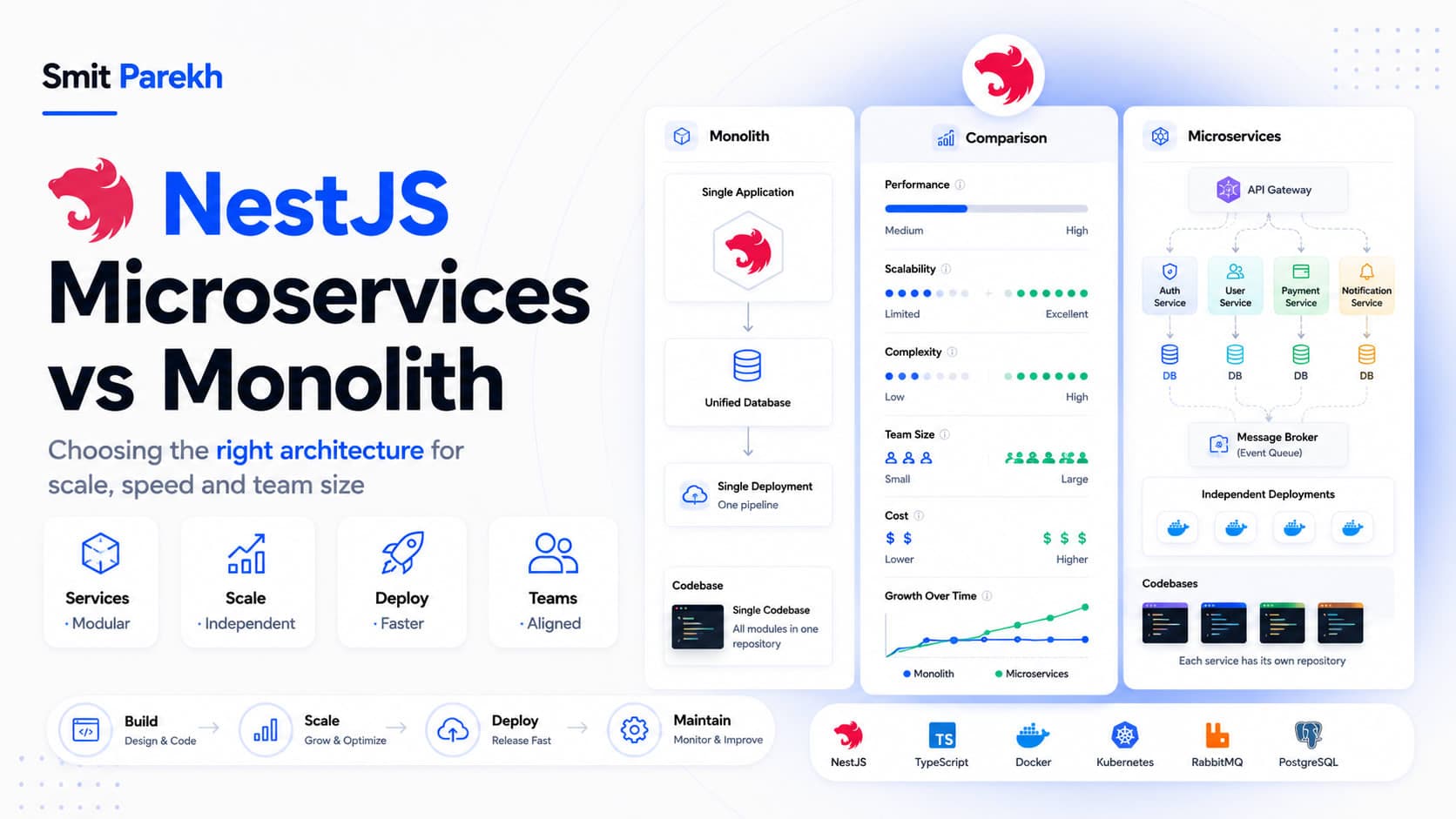
In a monolithic architecture, your entire application – including all business logic, data access, and API endpoints – resides within a single codebase and is deployed as a single unit. NestJS, with its module system, dependency injection, and clear structure (controllers, services, modules), provides an excellent foundation for building well-organized monoliths.
Advantages of a NestJS Monolith
- Simplicity in Development and Deployment: A single codebase means less context switching, easier local development setup, and simpler CI/CD pipelines. Deployment is often a matter of deploying one artifact.
- Unified Testing and Debugging: End-to-end testing is more straightforward, and debugging across different parts of the application is easier as all code runs in the same process.
- Lower Operational Overhead: Fewer services to monitor, scale, and manage translate to less infrastructure cost and a smaller DevOps burden.
- Strong Cohesion: All components are tightly coupled, which can be beneficial when features require deep integration across multiple application layers.
When a NestJS Monolith Shines
I've shipped many successful NestJS monoliths, especially for startups or projects with predictable scope. They are ideal for:
- Small to Medium-sized Projects: When the domain is well-understood and the team is small (e.g., 2-10 developers).
- Rapid Prototyping/MVP: Get to market faster without the overhead of distributed systems.
- Stable Requirements: When the business logic is unlikely to change drastically over time.
Embracing NestJS Microservices
Microservices break down an application into a suite of small, independently deployable services, each running its own process and communicating via lightweight mechanisms (e.g., HTTP APIs, message queues). NestJS provides robust support for microservices through its @nestjs/microservices package, enabling various transport layers like TCP, Redis, gRPC, and Kafka.
Advantages of NestJS Microservices
- Independent Scalability: Services can be scaled individually based on their specific load, optimizing resource utilization. For instance, your
OrderServicecan scale independently of yourUserService. - Technology Heterogeneity: Different services can be written in different languages or frameworks, though sticking with NestJS across services often simplifies the ecosystem.
- Improved Resilience: The failure of one service doesn't necessarily bring down the entire application. Fault isolation is a key benefit.
- Independent Deployment: Teams can deploy services independently, reducing deployment risks and enabling faster release cycles.
- Team Autonomy: Smaller, cross-functional teams can own specific services end-to-end, fostering ownership and accelerating development.
When NestJS Microservices Make Sense
From a technical consulting perspective, I recommend microservices when:
- Large and Complex Systems: For applications with diverse functionalities and large development teams (e.g., 20+ developers).
- High Scalability Requirements: When different parts of the application experience vastly different load patterns.
- Evolving Business Domains: When certain business capabilities are expected to change frequently and rapidly.
- Geographically Distributed Teams: Microservices can simplify collaboration across different time zones by providing clear service boundaries.
Key Architectural Trade-offs
Choosing between these architectures is a balancing act. Here's a table summarizing the core differences:
| Feature | NestJS Monolith | NestJS Microservices |
|---|---|---|
| Development | Simpler, faster initial setup | More complex, distributed development environment |
| Deployment | Single artifact, easier CI/CD | Multiple independent deployments, complex CI/CD |
| Scalability | Scales as a whole (vertical or horizontal) | Independent scaling per service (horizontal) |
| Resilience | Single point of failure | Fault isolation, higher resilience |
| Complexity | Lower operational complexity | Higher operational and distributed system complexity |
| Data Management | Shared database, easier transactions | Distributed data, eventual consistency challenges |
| Team Size | Small to medium teams | Large, autonomous teams |
| Cost (Dev/Ops) | Lower initial development, lower operational costs | Higher initial development, higher operational costs |
Operational Complexity and Cost
Transitioning from a monolith to microservices significantly increases operational overhead. You're no longer managing one database, but potentially many. Monitoring, logging, tracing, and service discovery become critical and require robust tooling. This often translates to higher infrastructure costs and a need for experienced DevOps engineers, which can be a significant investment (e.g., an additional $80k-$150k USD/CAD/GBP/INR annually for a skilled engineer).
Data Consistency
In a monolith, ACID transactions simplify data consistency. With microservices, you often deal with distributed transactions and eventual consistency models (e.g., Sagas). This requires careful design and can be a source of bugs if not handled correctly.
// Example of a NestJS microservice client using TCP transport
import { Injectable, OnModuleInit } from '@nestjs/common';
import { Client, ClientProxy, Transport } from '@nestjs/microservices';

@Injectable()
export class OrderService implements OnModuleInit {
  @Client({
    transport: Transport.TCP,
    options: { host: 'localhost', port: 8877 },
  })
  private client: ClientProxy;

  async onModuleInit() {
    await this.client.connect(); // Connect to the microservice
  }

  async createOrder(data: any) {
    // Send a message to the 'order' microservice
    return this.client.send('createOrder', data).toPromise();
  }
}

// Example of a NestJS microservice controller handling the 'createOrder' pattern
// In a separate service file or module
import { Controller } from '@nestjs/common';
import { MessagePattern } from '@nestjs/microservices';

@Controller()
export class OrderMicroserviceController {
  @MessagePattern('createOrder') // Listens for 'createOrder' messages
  handleCreateOrder(data: any): string {
    console.log('Order received:', data);
    // Process order, save to DB, etc.
    return `Order ${data.id} created successfully`;
  }
}
When to Re-evaluate: Monolith-to-Microservices
It's a common industry recommendation to start with a well-structured monolith and only migrate to microservices when the pain points of the monolith become significant. These pain points typically include:
- Slow Development Velocity: The codebase becomes too large for a single team, leading to merge conflicts and integration issues.
- Scalability Bottlenecks: Specific parts of the application require disproportionate scaling.
- Technology Debt: Difficulty in upgrading or changing core technologies due to tight coupling.
- Deployment Risks: Deploying the entire application becomes risky and time-consuming.
FAQ
Q: Is NestJS good for microservices?
A: Yes, NestJS is exceptionally well-suited for building microservices. Its modular design, dependency injection system, and dedicated @nestjs/microservices package simplify inter-service communication via various transport layers like TCP, Redis, and gRPC.
Q: What is the main difference between a monolith and microservices?
A: A monolith is a single, unified codebase and deployable unit, whereas microservices are a collection of small, independent services, each with its own codebase and deployment, communicating over a network.
Q: When should I choose a monolithic architecture?
A: Choose a monolithic architecture for smaller projects, MVPs, or when you have a small team, stable requirements, and value faster initial development, simpler deployment, and lower operational overhead.
Q: How do microservices communicate in NestJS?
A: In NestJS, microservices communicate using various transport layers defined by the @nestjs/microservices package. Common methods include TCP sockets, Redis pub/sub, gRPC for high-performance RPC, and Kafka for robust message queuing.
Q: Can a NestJS monolith be refactored into microservices later?
A: Yes, a well-architected NestJS monolith, with clear module boundaries and domain-driven design principles, can be refactored into microservices. This process typically involves extracting modules into separate services, a pattern often called a 'strangler fig' migration.
Final thoughts
The decision between NestJS microservices and a monolith isn't about choosing a superior architecture, but rather the right architecture for your specific context, team, and budget. For most projects, starting with a well-organized NestJS monolith provides a solid foundation, allowing you to iterate quickly and defer the complexity of distributed systems until it's truly necessary. When scalability, resilience, and team autonomy become critical pain points, NestJS provides all the tools you need to gracefully transition to a microservices architecture.
If you're navigating complex architectural decisions for your next project and want a second pair of senior eyes, get in touch to discuss your needs. I've helped numerous clients ship robust and scalable solutions, from initial design to production deployment, leveraging NestJS, React, Node.js, and modern DevOps practices.