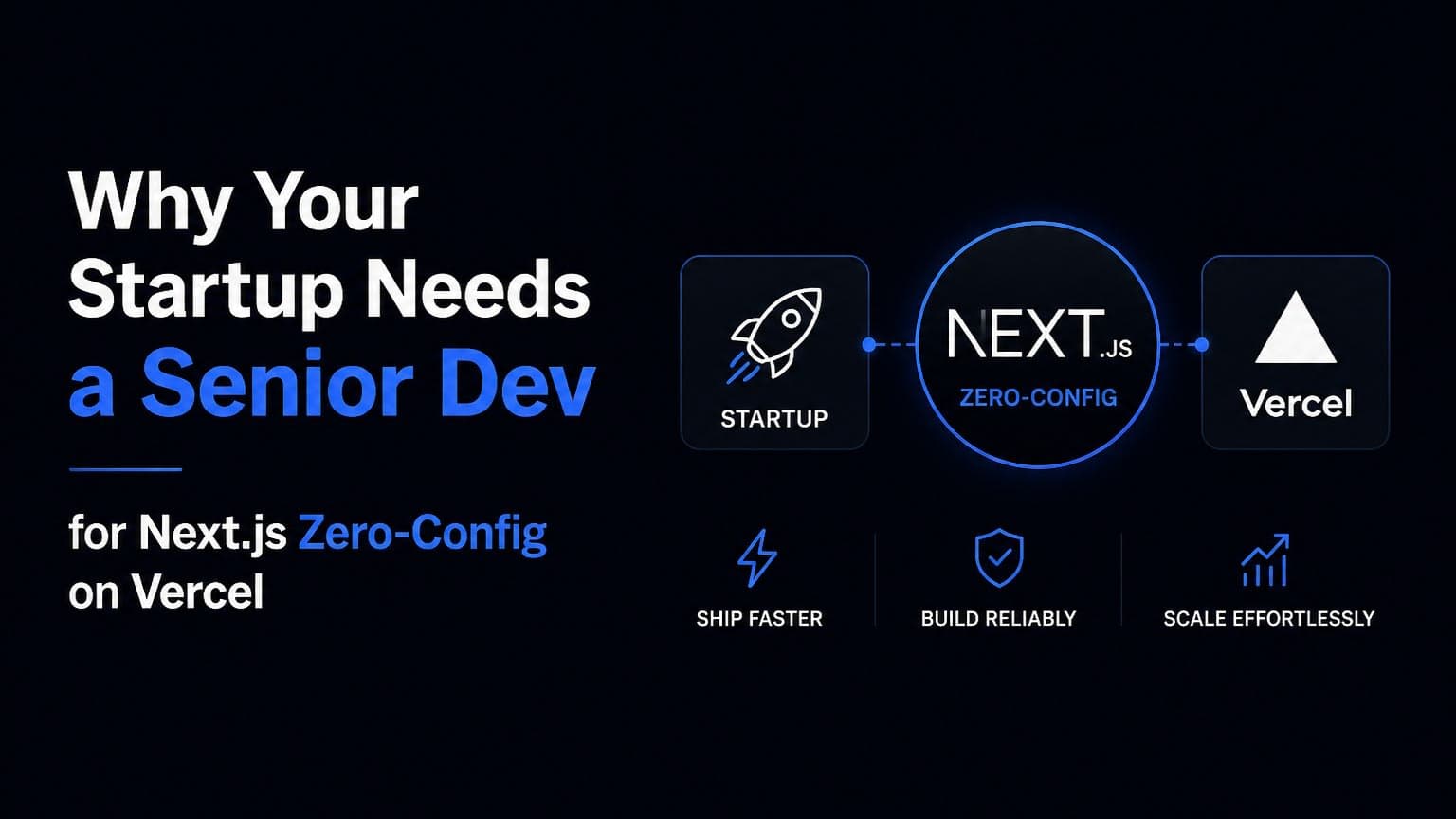
Building a startup means moving fast, but speed without direction often leads to costly rework and missed opportunities. Many founders are drawn to the promise of Next.js and Vercel's zero-config deployments, envisioning a frictionless path from code to production. While the initial setup is indeed straightforward, truly leveraging Next.js zero-config on Vercel for a scalable, performant, and maintainable application requires a depth of experience that only a senior developer brings to the table.
TL;DR
- Zero-config isn't zero-thought: Senior devs apply architectural wisdom to seemingly simple setups.
- Prevent tech debt: Experienced eyes identify and mitigate future scaling issues early.
- Optimize performance & cost: Go beyond defaults for efficient resource use and lower bills.
- Strategic feature delivery: Prioritize and implement features aligned with business goals, not just code.
- Mentor and elevate: A senior engineer upskills your entire team, fostering best practices.
The Illusion of 'Zero-Config' Simplicity
Vercel markets Next.js deployment as 'zero-config,' and it largely is for basic projects. git push and voilà, your site is live. However, for a growing startup, 'zero-config' quickly evolves into 'zero-control' if you lack the expertise to understand the underlying optimizations and potential bottlenecks. A senior developer doesn't just push code; they architect for scale, security, and maintainability from day one, anticipating the complexities that emerge as your user base expands or features become more intricate.
Beyond the vercel deploy Command
While Vercel handles serverless function provisioning, caching, and CDN distribution automatically, a senior developer dives deeper. They understand how to structure API routes for optimal cold start performance, configure custom cache-control headers for different content types, and leverage Vercel's Edge Network for global user experiences. This isn't about overriding defaults but intelligently augmenting them to fit your specific application's needs.
Strategic Architecture for Scalability and Maintainability
Junior developers often focus on getting features out the door. A senior developer, on the other hand, thinks about the entire lifecycle of the application. They'll consider how data fetching strategies (SSR, SSG, ISR, Client-side) impact performance and Vercel function invocation costs. They'll design a robust component architecture, set up effective state management, and ensure code splitting is optimized, all while working within the Next.js framework.
Example: Data Fetching Strategy Checklist
Here's a simplified checklist a senior developer might run through when deciding on a data fetching strategy for a new page or component:
- Is the data public and non-user-specific?
- Consider: Static Site Generation (SSG) with
getStaticPropsfor maximum performance and low cost. - If frequently updated: Incremental Static Regeneration (ISR) with
revalidateoption.
- Consider: Static Site Generation (SSG) with
- Does the data need to be fresh on every request and is it user-specific/dynamic?
- Consider: Server-Side Rendering (SSR) with
getServerSideProps. - Caution: Monitor Vercel function duration and cold starts. Optimize API calls.
- Consider: Server-Side Rendering (SSR) with
- Is the data highly dynamic, frequently updated, or dependent on client-side interactions?
- Consider: Client-Side Fetching (CSF) using
useEffector a data fetching library like SWR/React Query. - Ensure: Good loading states and error handling.
- Consider: Client-Side Fetching (CSF) using
- Are there hybrid scenarios?
- Consider: Pre-render static shell with SSG/SSR, then hydrate dynamic parts client-side.
// Example of ISR with revalidate option
export async function getStaticProps() {
  const res = await fetch('https://api.example.com/posts');
  const posts = await res.json();

  return {
    props: {
      posts,
    },
    // Revalidate every 60 seconds
    revalidate: 60, // In seconds
  };
}

// Example of SSR for dynamic, fresh data
export async function getServerSideProps(context) {
  const { id } = context.query;
  const res = await fetch(`https://api.example.com/item/${id}`);
  const item = await res.json();

  if (!item) {
    return {
      notFound: true,
    };
  }

  return {
    props: { item },
  };
}
Optimizing Performance and Cost Efficiency
Vercel's usage-based billing means that inefficient code or poor architectural decisions can quickly escalate costs. A senior developer understands the trade-offs. They'll optimize image loading with next/image, apply granular caching strategies, and minimize serverless function invocations. This translates directly into lower hosting bills (potentially saving hundreds to thousands of USD/CAD/GBP/INR monthly for high-traffic apps) and a snappier user experience, which is critical for conversion and retention.
Monitoring and Alerting
Beyond initial setup, a senior engineer establishes robust monitoring and alerting using Vercel Analytics, third-party tools like Datadog or Sentry, and custom dashboards. They're not just reacting to issues but proactively identifying performance regressions, cold start spikes, or unexpected costs before they impact users or the budget.
Beyond Code: Mentorship and Technical Leadership
A senior developer does more than write code; they elevate the entire team. They introduce best practices, conduct thorough code reviews, and mentor junior and mid-level engineers. This institutional knowledge transfer is invaluable, building a stronger, more resilient engineering culture. They act as a technical leader, translating business requirements into actionable technical tasks and making informed decisions about technology adoption and toolchains.
DevOps and AI/LLM Integration
For startups venturing into AI/LLM integration, a senior full-stack engineer is indispensable. They can architect the integration points, handle complex data flows, manage API keys securely, and optimize the serverless functions that interact with AI models. Understanding the nuances of cold starts for compute-heavy AI tasks on Vercel's serverless platform is a specific skill that can save significant development time and operational costs. They can also set up robust CI/CD pipelines, integrating testing and deployment automation beyond Vercel's defaults, ensuring a smooth, secure, and repeatable release process.
FAQ
Q: Isn't Next.js and Vercel easy enough for anyone to use?
A: For basic sites, yes. However, scaling a complex application, optimizing performance, managing costs, and integrating advanced features like AI requires deep expertise in Next.js internals, Vercel's platform features, and general software architecture principles that a senior developer brings.
Q: How much more expensive is a senior developer compared to a junior?
A: While senior developers command higher salaries (e.g., $120k+ USD/year), their ability to prevent costly mistakes, optimize infrastructure, and accelerate development often results in a significantly higher ROI. They can save your startup far more than their salary in reduced hosting costs, faster time-to-market, and avoiding technical debt.
Q: Can't I just learn these advanced concepts myself?
A: You can, but a startup's runway is finite. A senior developer has years of experience and has already made and learned from mistakes. Hiring one means you're leveraging that accumulated wisdom immediately, allowing you to focus on product and market fit rather than getting bogged down in infrastructure nuances.
Q: What specific benefits does a senior dev bring to Vercel deployments?
A: They optimize serverless function invocation patterns, configure advanced caching strategies (Edge Caching, ISR), secure environment variables, debug complex build failures, manage custom domains and DNS, and set up robust monitoring and alerting for production deployments.
Final thoughts
The allure of Next.js and Vercel's 'zero-config' promise is powerful, offering unparalleled developer experience and speed. But to truly unlock its potential for a growing startup, you need more than just someone who can get code deployed. You need a senior developer who can architect for the long term, optimize for performance and cost, and lead your technical vision. Their expertise isn't just a cost; it's an investment that pays dividends in stability, scalability, and ultimately, your startup's success. If you're building something ambitious and want a second pair of senior eyes to master your Next.js and Vercel setup, get in touch – I'd be happy to discuss how I can help your team ship faster and smarter. You can also explore my portfolio to see examples of complex Next.js applications in production.