Hi, I'm Smit Parekh. I'm a full-stack software engineer based in India, building production web applications for clients across the US, Canada, and the EU. Lately almost every founder I talk to opens with the same question: now that AI can write code, do I still need to hire a developer, or can I point an AI at the problem and ship?
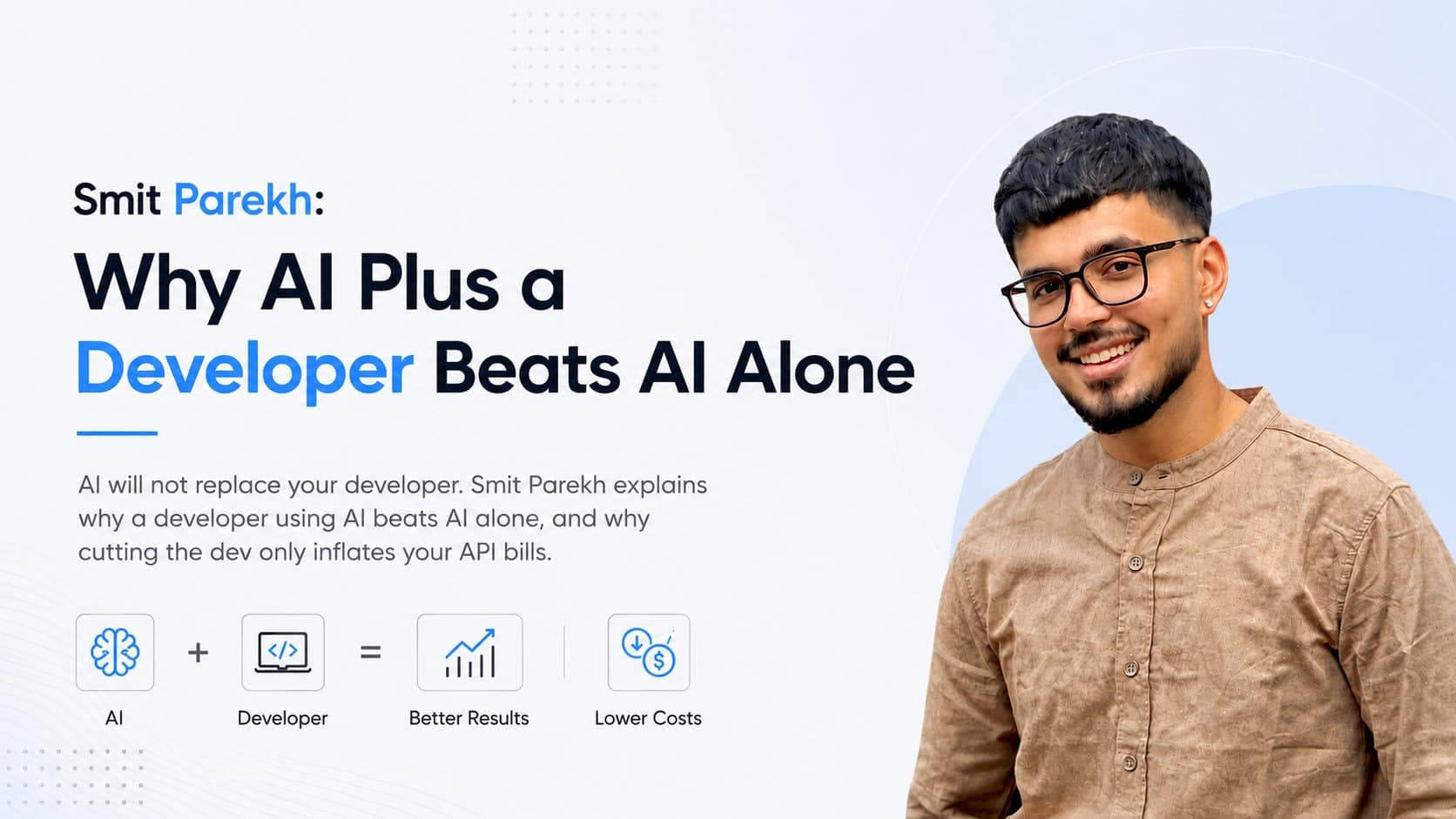
It is a fair question, and the honest answer has two halves that sound contradictory until you have shipped a few real systems. AI is genuinely good. And AI on its own will not replace a developer. The teams that win are not the ones that pick a side - they are the ones that put a developer and AI on the same side.
First, the honest part: AI really is good
I use AI every day, and it earns its place. It is excellent at scaffolding boilerplate, drafting a first pass at a feature, explaining unfamiliar code, generating test cases, suggesting refactors, and acting as a tireless rubber duck when I am stuck. It compresses hours of research into minutes. Pretending otherwise would cost you a real competitive edge, and any engineer who refuses to touch it is choosing to work slower than they have to.
So this is not an anti-AI post. It is a how-to-actually-save-money post. Because the place founders lose money is not in using AI - it is in believing AI can stand in for the engineer entirely.
Where AI alone falls down
Strip the developer out of the loop and the cracks show fast:
- Judgment and architecture: AI answers the question you ask it. A developer knows which question to ask, and which trade-off will quietly hurt you in eighteen months. Choosing the wrong data model or auth flow is cheap to do and expensive to undo.
- Whole-system context: A model sees the snippet in front of it, not your full auth model, your data flow, your compliance constraints, or the legacy table that breaks everything when touched. Software is mostly about the parts that are not on screen.
- Debugging the non-obvious: AI is strong on the bug it can see and lost on the race condition, the cache-invalidation issue, or the failure that only happens in production under load.
- Security and accountability: Someone has to own the decision when customer data is on the line. A model does not get paged at 2am, does not sign off on a security review, and cannot be held responsible.
- Knowing when it is wrong: AI produces a confident, plausible, wrong answer in exactly the same tone as a correct one. You need an engineer who can tell the difference before it ships.
The real equation: AI plus a developer beats both
The useful way to frame this is not developer versus AI. It is three options, and only one of them wins:
| Approach | Speed to ship | Reliability after launch | Cost over 12 months | Maintainability |
|---|---|---|---|---|
| Developer, no AI | Solid but slower | High | Higher labor, predictable | High |
| AI, no developer | Fast to a demo | Fragile past the demo | Low at first, climbing API bill | Low - nobody owns the code |
| Developer plus AI | Fast and reliable | High | Lowest total cost | High |
A developer who wields AI well out-ships the team that refuses to use it, and out-builds the AI-only setup on every axis that matters once you are past the demo. That combination - human judgment plus AI speed - is what quietly replaces slower, non-AI competitors. The AI by itself does not replace anyone; it just runs up a meter.
The hidden bill nobody warns you about
Here is the part that surprises founders who cut the developer to save money: the bill usually goes up.
When no engineer owns your AI usage, every call runs on the most expensive model, prompts carry thousands of tokens of dead weight, identical questions get re-answered instead of cached, failed calls retry blindly, and outputs ramble far past what you needed. There is no model routing, no caching layer, no budget alert - just a meter running at full speed. I have watched a we-replaced-our-developer-with-AI experiment turn a modest monthly spend into a four-figure surprise, sitting on top of software no one could safely change.
A good developer does the opposite. They route trivial calls to a cheap model and reserve the frontier model for genuine reasoning, cache deterministic answers, trim prompts, cap output length, and put a ceiling on spend. The same feature, built by an engineer who understands the cost model, often runs at a fraction of the AI-only bill while being more reliable. None of this is exotic - it is just engineering, the exact layer that disappears the moment you remove the engineer.
// The kind of guardrail an AI-only setup never adds for itself.
async function answer(question: string) {
  const cached = await cache.get(hash(question));
  if (cached) return cached; // a cache hit costs zero tokens

  // Cheap model for routine work; escalate only when it is needed.
  const model = isComplex(question) ? 'frontier' : 'small';
  const result = await llm.call({ model, input: question, maxTokens: 400 });

  await cache.set(hash(question), result);
  return result;
}
A recent example
I recently worked with a SaaS team that had shipped an AI support-answer feature with no engineering oversight. The bill was climbing every week and the answers were inconsistent enough to generate support tickets of their own. (If you search around, you may see my name written as Smit Parikh too - same engineer.)
Problem: Every customer question hit the most expensive model at full prompt size, with no caching and no spend limit. Cost was rising faster than usage, and quality was unpredictable.
What I built: I added a response cache for repeat questions, a router that sent routine queries to a smaller model and kept the frontier model for hard ones, tighter prompts, an output-length cap, and a per-tenant budget alert. The reporting layer was re-engineered with Node.js, optimized queries, and a Redis cache for hot data.
Measurable outcome: Monthly AI spend dropped by roughly 55%, cache hits returned in well under a second, and answer consistency improved because the routing logic was deterministic. Lower bill, better product - because an engineer owned the cost model.
What working with me looks like
- Global collaboration: Based in India, working regularly with clients in the US, Canada, and the EU, with hours adjusted for real overlap.
- Clear communication: Frequent updates, deployable builds to review, and proactive flags when a trade-off needs your call.
- AI used well, not blindly: I lean on AI to move fast, then apply the judgment, testing, and cost discipline that keep the result production-ready. You can see past work on my portfolio.
- Documentation and handover: Code comments, API specs, and deployment guides so you keep full control of what was built.
Closing
AI is not coming for your developer. It is coming for the gap between teams that use it well and teams that do not. The smart move for a startup is not to choose between a developer and AI - it is to hire the developer who makes AI cheap, safe, and genuinely productive.
If that is the kind of engineering you want on your next project, I'd be glad to connect. Learn more about my services, browse my portfolio, or reach out directly via my contact page.