If you run a small engineering team, the monorepo-versus-polyrepo debate probably feels louder than it should. Both sides have loud advocates, both point to companies you admire, and both quietly ignore that what works at Google or Meta has almost nothing to do with a five-person startup. So let me give you the short answer first, then the framework.
For most small teams shipping a tightly-coupled product, a monorepo wins. It removes friction you feel every single day. Polyrepo earns its place when your services are genuinely independent, owned by separate teams, or released on separate schedules. That is the whole debate in two sentences. The rest of this article is about knowing which situation you are actually in.
What These Terms Actually Mean
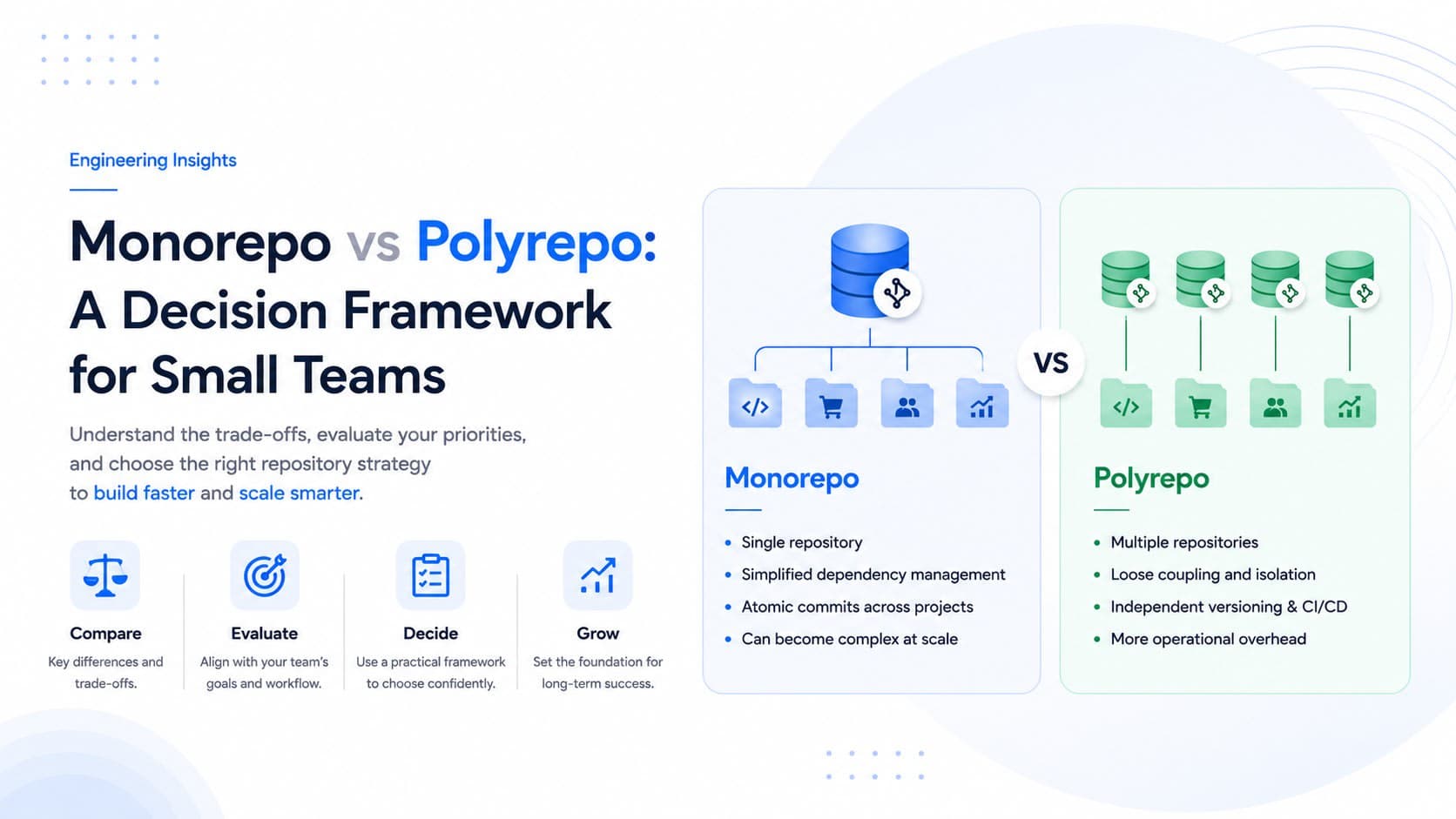
A monorepo is a single version-controlled repository that holds multiple projects, packages, or services. One git clone, one place for issues and pull requests, one source of truth for shared code. A polyrepo (also called multi-repo) splits each project, service, or library into its own repository, each with its own history, CI pipeline, and access controls.
Note what a monorepo is not: it is not a monolith. A monolith is an architectural choice about how your code runs in production. A monorepo is a choice about how your code is stored. You can have a monorepo full of microservices, or a polyrepo containing one giant monolith. Conflating the two is the single most common mistake in this conversation.
The Forces That Actually Matter
Forget what the big companies do. For a small team, the decision comes down to four forces.
1. How coupled is your code?
The most important question. If a change to your API almost always requires a matching change to your frontend, your code is tightly coupled, and a monorepo lets you make that change in a single atomic commit. In a polyrepo, the same change means two pull requests across two repositories, version bumps, and a window where the two repos are out of sync.
For a small team building one product, coupling is usually high. This is the strongest argument for monorepo and the one most people underweight.
2. How do you share code?
Do you have shared types, a UI component library, validation logic, or utility functions used across projects? In a monorepo, shared code is just an import away, and a change propagates instantly. Everyone sees the same version, always.
In a polyrepo, sharing means publishing packages to a registry, versioning them, and updating consumers one by one. This is fine at scale with dedicated tooling, but for a team of three it is pure overhead. TypeScript teams feel this especially hard, since sharing types across repo boundaries without a monorepo is genuinely painful.
3. Who owns what?
Polyrepo shines when ownership boundaries are crisp. If team A owns the billing service and team B should never touch it, separate repos with separate permissions enforce that cleanly. But small teams rarely have these boundaries. Everyone touches everything. Imposing repo-level ownership on a team that does not have ownership boundaries just creates artificial walls you have to climb over daily.
4. Do your pieces release on different schedules?
If your mobile app, your marketing site, and your API all ship independently with their own cadences and rollback needs, separate repos map naturally to those separate lifecycles. If everything deploys together when you cut a release, a monorepo matches reality better.
The Decision Framework
Score your situation. Lean monorepo if most of these are true:
- Your code is tightly coupled (frontend and backend change together).
- You share types, components, or logic across projects.
- Your team is small enough that everyone touches most of the codebase.
- You generally release things together or in lockstep.
- You want one place for CI, linting, and dependency management.
Lean polyrepo if most of these are true:
- Your services are genuinely independent and rarely change together.
- Different people or teams own different pieces with hard boundaries.
- Components release on separate, unrelated schedules.
- You need strict per-repository access control (open-source one piece, keep another private).
- A repo is so large that tooling performance becomes a real problem.
For a typical small team building a web product with Next.js, Node, and shared TypeScript types, four or five of the monorepo signals usually light up. That is not an accident. It is why the JavaScript ecosystem has leaned hard into monorepos over the last few years.
The Tooling Question
Historically, the case against monorepos was tooling pain: slow CI because everything rebuilds, messy dependency graphs, and version conflicts. That argument has weakened considerably.
Modern tools handle this well. npm, pnpm, and yarn all support workspaces natively, letting you manage multiple packages in one repo with proper dependency hoisting. On top of that, build orchestrators like Turborepo and Nx add intelligent caching and task scheduling, so you only rebuild and retest what actually changed. A well-configured monorepo can have faster effective CI than a polyrepo, because it skips work that did not change.
For a small team, pnpm workspaces plus Turborepo is a strong, low-config default. You get shared code, atomic commits, and selective builds without standing up complex infrastructure.
The polyrepo side has tooling too, but most of it solves coordination problems: dependency-update bots, contract testing between services, and package registries. The tell is in the nature of these tools. Monorepo tooling makes one big thing faster. Polyrepo tooling makes many separate things stay in sync. If you do not feel the pain those polyrepo tools solve, you do not need a polyrepo.
Common Mistakes
Choosing polyrepo because it feels more "professional." It is not more professional. It is more appropriate for certain ownership structures. Splitting a three-person team across eight repos does not make you Google; it makes a simple change require eight clones.
Choosing monorepo and then never configuring caching. If you put everything in one repo and run the full test suite on every commit, you will feel the slowness people warned you about. The caching is the point. Set it up.
Treating the decision as permanent. It is not. Migrating from a monorepo to polyrepo, or merging repos together, is real work but entirely doable. Pick the option that fits the team you have today, not the company you hope to become in five years.
My Recommendation
If you are a small team and unsure, start with a monorepo. The daily friction is lower, shared code is trivial, and atomic commits across your stack will quietly save you from a whole class of integration bugs. Reach for polyrepo when you hit a concrete reason: a service that needs different access control, a component on a wildly different release schedule, or genuine independent team ownership.
Do not choose based on what scales to a thousand engineers. Choose based on how your five people actually work this quarter. The right answer is the one that removes friction from the work you are doing right now, and for most small teams, that is a monorepo.