Building robust enterprise web applications often requires a delicate balance between budget, expertise, and time-to-market. For many organizations, the critical decision lies in whether to engage a freelance senior developer or a full-service agency. This article dissects the nuanced costs and value propositions of both options for complex projects, helping you make an informed choice.
TL;DR
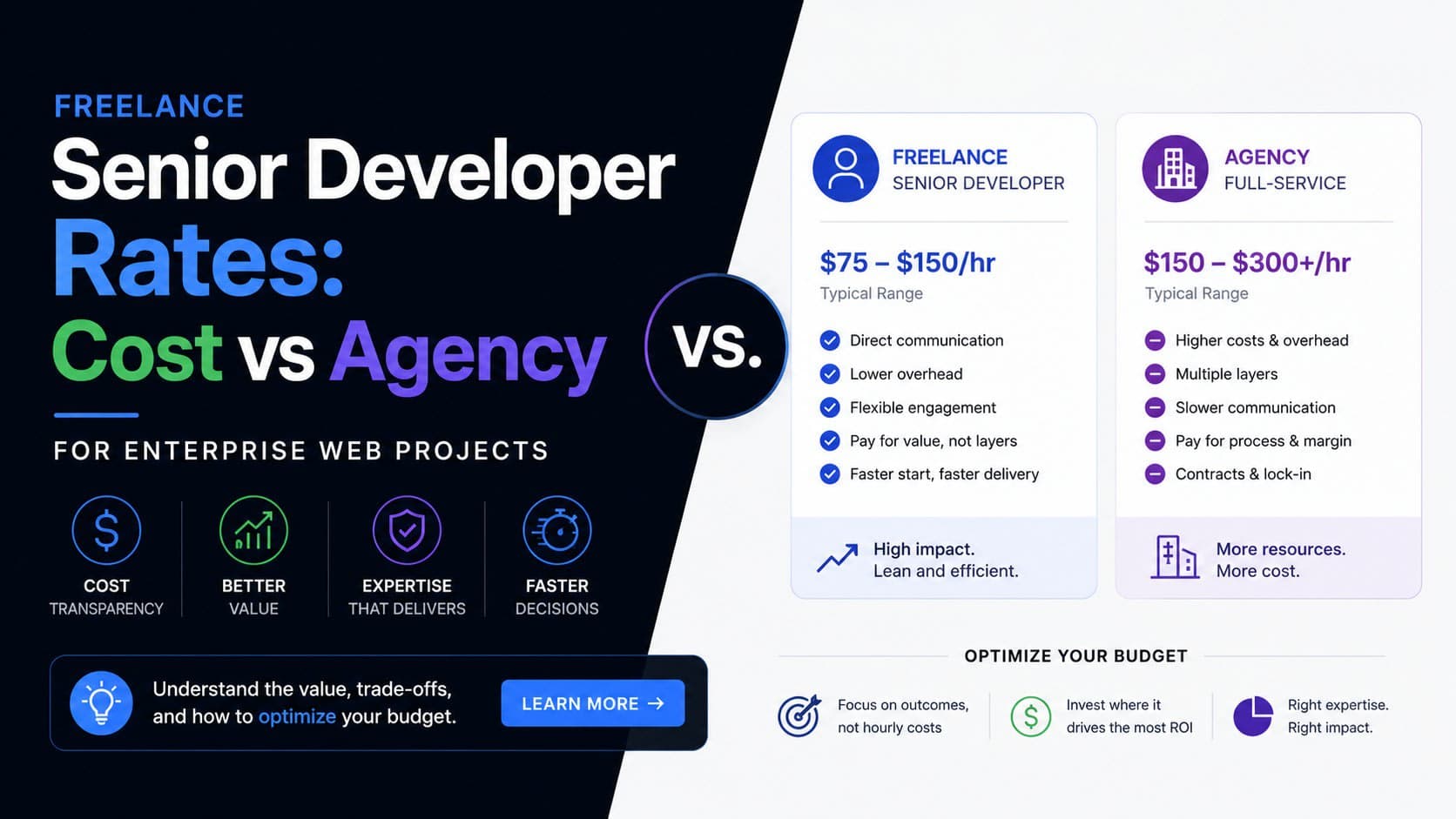
- Freelance senior developer rates generally range from $100-$300 USD/hour, offering deep expertise and direct communication at a lower overhead than agencies.
- Agencies typically charge $150-$450+ USD/hour, providing broader services (design, QA, project management) but with higher overheads and potentially less direct developer access.
- For enterprise web projects, a blend of freelance specialists and internal coordination often delivers the best balance of cost-efficiency and specialized skills.
- Evaluate project complexity, required team size, and long-term maintenance needs when deciding between the two models.
Understanding Senior Developer Rates: What You're Paying For
When hiring a senior developer, whether freelance or through an agency, you're investing in more than just lines of code. You're acquiring years of experience, a proven track record of shipping complex features, architectural foresight, and the ability to mentor junior team members. A senior developer can often prevent costly mistakes down the line, debug intricate systems quickly, and design scalable solutions from the ground up.
Factors Influencing Freelance Senior Developer Rates
Freelance senior developer rates vary significantly based on several factors:
- Expertise & Niche Skills: Specialists in Next.js, React, Node.js, TypeScript, or AI/LLM integration often command higher rates due to demand and scarcity. My own experience in architecting complex data flows with these technologies has shown clients the value of upfront design.
- Location & Cost of Living: While a remote freelancer might be based anywhere, their desired compensation often reflects their local economy and target income. Expect rates to vary across the US, Canada, UK, and India, for instance.
- Project Duration & Scope: Longer-term engagements or retainer agreements might see slightly reduced hourly rates compared to short, intensive sprints.
- Market Demand: Technologies in high demand (like a senior React developer for a greenfield project) will naturally attract higher rates.
Here's a general hourly rate benchmark for a senior freelance developer:
| Region | Typical Hourly Rate (USD) | Typical Hourly Rate (CAD) | Typical Hourly Rate (GBP) | Typical Hourly Rate (INR) |
|---|---|---|---|---|
| USA | $150 - $300 | $200 - $400 | £120 - £250 | ₹10,000 - ₹25,000 |
| Canada | $120 - $250 | $160 - $330 | £100 - £200 | ₹8,000 - ₹20,000 |
| UK | $120 - $250 | $160 - $330 | £100 - £200 | ₹8,000 - ₹20,000 |
| India | $80 - $180 | $110 - $240 | £65 - £145 | ₹6,000 - ₹15,000 |
Note: These are broad ranges and can fluctuate based on specific skills, reputation, and demand.
The Agency Model: Comprehensive Services at a Premium
Agencies offer a complete package: a team of designers, developers, QA engineers, and project managers. This can be appealing for organizations lacking internal capacity or preferring a single point of contact for a large-scale project.
What Drives Agency Costs?
- Overhead: Agencies have significant overheads, including office space, administrative staff, sales teams, and marketing. These costs are factored into their hourly rates.
- Team Depth: You're not just hiring a developer; you're getting access to a diverse team, often with specialized roles like UX researchers, DevOps engineers, and technical architects.
- Project Management: Agencies typically provide dedicated project management, handling timelines, communication, and resource allocation.
- Risk Mitigation: They often absorb some project risks, offering guarantees or fixed-price contracts for specific deliverables.
Agency hourly rates for senior-level work can range from $150-$450+ USD/hour. While seemingly higher, this reflects the all-inclusive nature of their service.
Cost vs. Value: Making the Right Choice for Enterprise Web Projects
For enterprise web projects, the decision isn't just about the raw hourly rate. It's about total cost of ownership, speed, quality, and long-term maintainability.
When a Freelance Senior Developer Shines
- Deep Technical Expertise: When you need highly specialized skills (e.g., optimizing a Next.js application for edge performance, integrating complex AI/LLM models, or refactoring a legacy Node.js backend), a seasoned freelancer can dive deep without the overhead of a full team.
- Direct Communication & Agility: You work directly with the expert, leading to faster iterations and clearer communication. In a recent client project, I was able to rapidly prototype and integrate a custom LLM solution, something that would have involved multiple layers of approval and communication with an agency.
- Cost Efficiency for Specific Sprints: For targeted feature development, bug fixing, or architectural consulting, a freelancer can be significantly more cost-effective.
- Filling Gaps in an Existing Team: If your in-house team needs a senior lead for a specific module or a DevOps expert to streamline CI/CD, a freelancer can integrate seamlessly.
When an Agency is the Better Fit
- Full-Stack Solution from Scratch: If you need an entire product built from concept to launch, including discovery, UX/UI design, development, QA, and deployment, an agency provides a single vendor solution.
- Large-Scale, Multi-Disciplinary Projects: For projects requiring a large, diverse team working concurrently (e.g., a major platform re-platforming with complex integrations and extensive user research).
- Lack of Internal Capacity/Leadership: If your organization lacks internal technical leadership or project management capabilities, an agency can fill that void.
- Fixed-Price Contracts: For projects with well-defined scopes and little room for change, agencies might offer fixed-price models, providing budget predictability (though often at a higher overall cost to cover their risk).
The Hybrid Approach: Best of Both Worlds?
Many forward-thinking enterprises adopt a hybrid model. This involves leveraging an in-house core team or a few key freelance senior developers for critical architectural components and specialized tasks, while potentially outsourcing specific non-core modules or design work to smaller agencies or individual specialists.
For instance, an enterprise might:
- Hire a freelance senior Next.js architect to design the core application structure and data flow.
- Engage a freelance Node.js backend specialist for critical API development and database optimization.
- Work with a smaller design studio for specific UI/UX components.
- Utilize their internal team for ongoing feature development and maintenance.
This approach allows for maximum flexibility, cost control, and access to top-tier talent for the most crucial parts of the project.
// Example of a senior developer's architectural thinking:
// Enforcing type safety and clear domain separation in a Next.js API route

interface UserData {
  id: string;
  name: string;
  email: string;
}

interface UserCreateRequest {
  name: string;
  email: string;
}

// A robust API handler with input validation and error handling
export async function POST(request: Request) {
  try {
    const body: UserCreateRequest = await request.json();

    // Basic validation (in a real app, use Zod or similar)
    if (!body.name || !body.email) {
      return new Response(JSON.stringify({ error: 'Name and email are required.' }), { status: 400 });
    }

    // Simulate database interaction (e.g., Prisma, Mongoose)
    const newUser: UserData = {
      id: `usr_${Date.now()}`,
      name: body.name,
      email: body.email,
    };

    // In a production app, save to DB and handle potential errors
    console.log('User created:', newUser);

    return new Response(JSON.stringify(newUser), { status: 201 });
  } catch (error) {
    console.error('Failed to create user:', error);
    return new Response(JSON.stringify({ error: 'Internal server error.' }), { status: 500 });
  }
}
This snippet demonstrates the kind of structured, type-safe approach a senior developer brings to the table, ensuring maintainability and reducing bugs—a contrast to rapid, unvalidated prototypes.
FAQ
Q: Are freelance senior developers reliable for long-term enterprise projects?
A: Yes, many freelance senior developers specialize in long-term engagements. The key is clear contracts, communication, and mutual commitment. I've often worked with clients for 12+ months, becoming an integral part of their extended team.
Q: How do I vet a freelance senior developer's skills?
A: Look for a strong portfolio, public code (GitHub), testimonials, and conduct thorough technical interviews. Ask for examples of their work on complex systems, their approach to architectural challenges, and their experience with modern tech stacks like Next.js, React, Node.js, and TypeScript.
Q: What's the typical payment structure for freelancers vs. agencies?
A: Freelancers usually prefer hourly rates or fixed-price milestones, often requiring an upfront deposit. Agencies might offer fixed-price projects, time & material, or retainer models, often with more structured payment schedules and larger upfront commitments.
Q: Can a single freelance senior developer handle a full enterprise project?
A: Rarely. A single developer can architect, lead, and develop critical components, but a full enterprise project typically requires more resources for design, QA, and parallel development streams. A freelancer is often best used as a lead, a specialist, or to augment an existing team.
Final thoughts
Choosing between a freelance senior developer and an agency for your enterprise web project is a strategic decision that impacts your budget, timelines, and product quality. While agencies offer a comprehensive, hands-off approach, the direct expertise and cost-efficiency of a highly skilled freelancer, especially for specialized tasks or augmenting an existing team, often present a compelling alternative.
Understanding the value proposition of freelance senior developer rates allows you to optimize your investment, ensuring you get top-tier talent where it matters most. If you're navigating these choices for your next enterprise-level web application, particularly with Next.js, React, Node.js, or AI/LLM integration, and want a second pair of senior eyes, get in touch.
Need help shipping this in production? Let's talk.