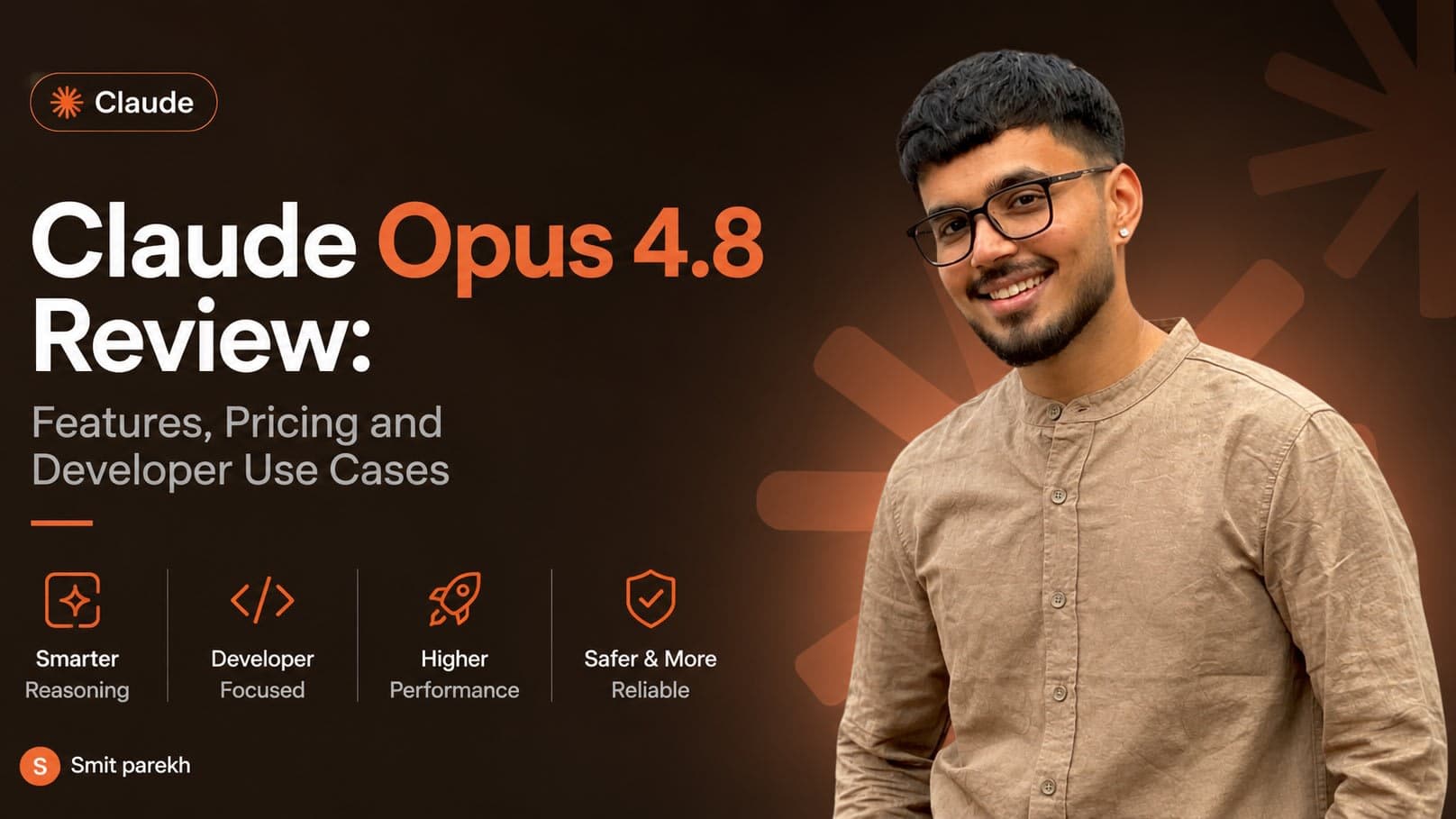
AI models continue evolving at a rapid pace, and each major release changes how developers build, test, and deploy software. Claude Opus 4.8 introduces several improvements aimed at coding workflows, reasoning tasks, and agentic development experiences.
As a full-stack developer and AI integration consultant, I constantly evaluate new AI models to understand where they create genuine business value and where they simply add hype. In this article, I will break down Claude Opus 4.8 from a practical developer perspective, focusing on features, pricing considerations, and real-world implementation opportunities.
Why Claude Opus 4.8 Matters
Modern AI development is no longer limited to simple chat interfaces. Businesses are increasingly integrating large language models into:
- SaaS platforms
- Internal business tools
- Customer support systems
- Workflow automation
- Developer productivity tools
- AI agents
- Knowledge management systems
The challenge is not finding a capable model. The challenge is selecting the right model for performance, cost, reliability, and scalability.
Claude Opus 4.8 aims to improve these areas while giving developers more control over how AI resources are consumed.
Key Improvements in Claude Opus 4.8
One of the biggest themes of this release is improved reasoning control.
Developers can better align model effort with task complexity, helping reduce unnecessary processing on simple tasks while allocating more reasoning resources to complex challenges.
Potential use cases include:
- Code reviews
- Architecture planning
- Multi-step debugging
- Documentation generation
- API design assistance
- Agent orchestration
This creates more flexibility compared to treating every request with the same level of reasoning intensity.
Better AI-Assisted Development
Many engineering teams now use AI throughout the development lifecycle.
Typical workflows include:
- Generating boilerplate code
- Refactoring legacy systems
- Creating test cases
- Explaining unfamiliar codebases
- Generating documentation
- Assisting with migrations
Claude Opus 4.8 appears focused on improving reliability for these scenarios.
In practical development environments, reliability is often more valuable than raw speed. A slightly slower response that correctly identifies edge cases is usually more useful than a fast answer that introduces hidden bugs.
Where Claude Opus 4.8 Fits Best
Not every project requires a premium reasoning model.
For basic classification tasks, lightweight models may provide better economics.
However, Claude Opus 4.8 becomes more attractive when dealing with:
- Complex code generation
- Multi-file refactoring
- Software architecture decisions
- AI agent workflows
- Long-context analysis
- Technical research
These are scenarios where deeper reasoning can justify additional cost.
Example Integration Using Node.js
Many businesses integrating AI into existing platforms use Node.js and TypeScript.
A simplified implementation may look like this:
typescript import Anthropic from "@anthropic-ai/sdk";
const client = new Anthropic({ apiKey: process.env.ANTHROPIC_API_KEY, });
async function reviewCode(code: string) {
const response = await client.messages.create({
model: "claude-opus-4-8",
max_tokens: 4096,
messages: [
{
role: "user",
content: Review this code and identify risks:\n${code},
},
],
});
return response; }
In production systems, developers typically add:
- Rate limiting
- Logging
- Caching
- Cost monitoring
- Error handling
- Retry strategies
- Analytics
These operational layers often determine whether an AI feature remains profitable over time.
Cost Optimization Matters
One mistake businesses frequently make is focusing only on model quality while ignoring operating costs.
A successful AI integration requires balancing:
- Response quality
- Latency
- Infrastructure costs
- API usage costs
- User experience
When implementing AI solutions, I often recommend using model routing strategies that reserve premium models for difficult tasks while using smaller models for routine operations.
This approach can significantly reduce long-term operating expenses.
Claude and Agentic Workflows
One of the most interesting trends in AI development is the rise of agentic systems.
Instead of generating a single answer, agents can:
- Plan tasks
- Gather information
- Execute actions
- Verify outputs
- Coordinate workflows
Claude Opus 4.8 is positioned well for these environments because complex agent systems require strong reasoning capabilities and long-context understanding.
Examples include:
- Automated code migrations
- Documentation generation
- Customer support automation
- Internal knowledge assistants
- Research workflows
As these systems become more common, model reliability becomes increasingly important.
Should Developers Upgrade?
For teams already building with Claude, upgrading may provide meaningful improvements depending on workload complexity.
The biggest benefits are likely to be seen by:
- Engineering teams
- AI startups
- SaaS companies
- Product teams
- Technical consultants
Organizations primarily using AI for simple text generation may see smaller benefits compared to teams solving complex technical problems.
My Perspective as an AI Integration Consultant
As Smit Parekh, I view AI models as tools rather than complete solutions.
The model itself is only one component of a successful implementation.
The real value comes from:
- System architecture
- Prompt engineering
- Cost controls
- User experience design
- Performance optimization
- Security considerations
- Monitoring and analytics
Businesses often focus on selecting a model while overlooking the engineering decisions that ultimately determine project success.
A properly designed AI system can outperform a more powerful model running inside a poorly designed architecture.
Work With Smit Parekh
Looking to integrate Claude, OpenAI, AI agents, workflow automation, chatbots, or custom LLM solutions into your business?
I help startups, SaaS companies, agencies, and founders build production-ready AI applications using Next.js, React, Node.js, TypeScript, cloud infrastructure, and modern AI platforms.
Services include:
- AI integration consulting
- Custom chatbot development
- AI workflow automation
- Next.js application development
- Technical SEO optimization
- Website redesign and migration
- Full-stack web development
Connect with me:
- Website: https://www.smitparekh.co.in/contact
- LinkedIn: https://www.linkedin.com/in/smitparekh84/
- X: https://x.com/smit_parekh84
- Upwork: https://www.upwork.com/freelancers/~018877bbeb80ff2d25
Final Thoughts
Claude Opus 4.8 represents another step forward in AI-assisted software development. While the feature improvements are important, the biggest opportunities come from how developers integrate these capabilities into real products and workflows.
The teams that gain the most value from AI are rarely the ones chasing benchmarks. They are the teams that combine strong engineering practices with modern AI capabilities to create faster, more reliable, and more scalable solutions.
For businesses evaluating AI adoption, the focus should remain on solving real problems, controlling costs, and building systems that continue delivering value long after the initial launch.