From idea to live product in 4-8 weeks
Investor-ready MVPs built with the right stack, the right scope, and a fixed price. Ship fast, validate with real users, and raise with confidence.
Most MVPs fail because they're either over-engineered (takes 6 months, costs $50K) or under-engineered (can't scale past 100 users). I've shipped 20+ MVPs and know exactly where to cut scope without cutting quality - auth, payments, core flows, and a deploy that doesn't embarrass you in a demo.
20+
MVPs shipped to real users
4-8 wks
Average time from kickoff to live
Fixed
Price - no scope creep surprises
30 days
Post-launch bug-fix support
Trusted by founders & teams in

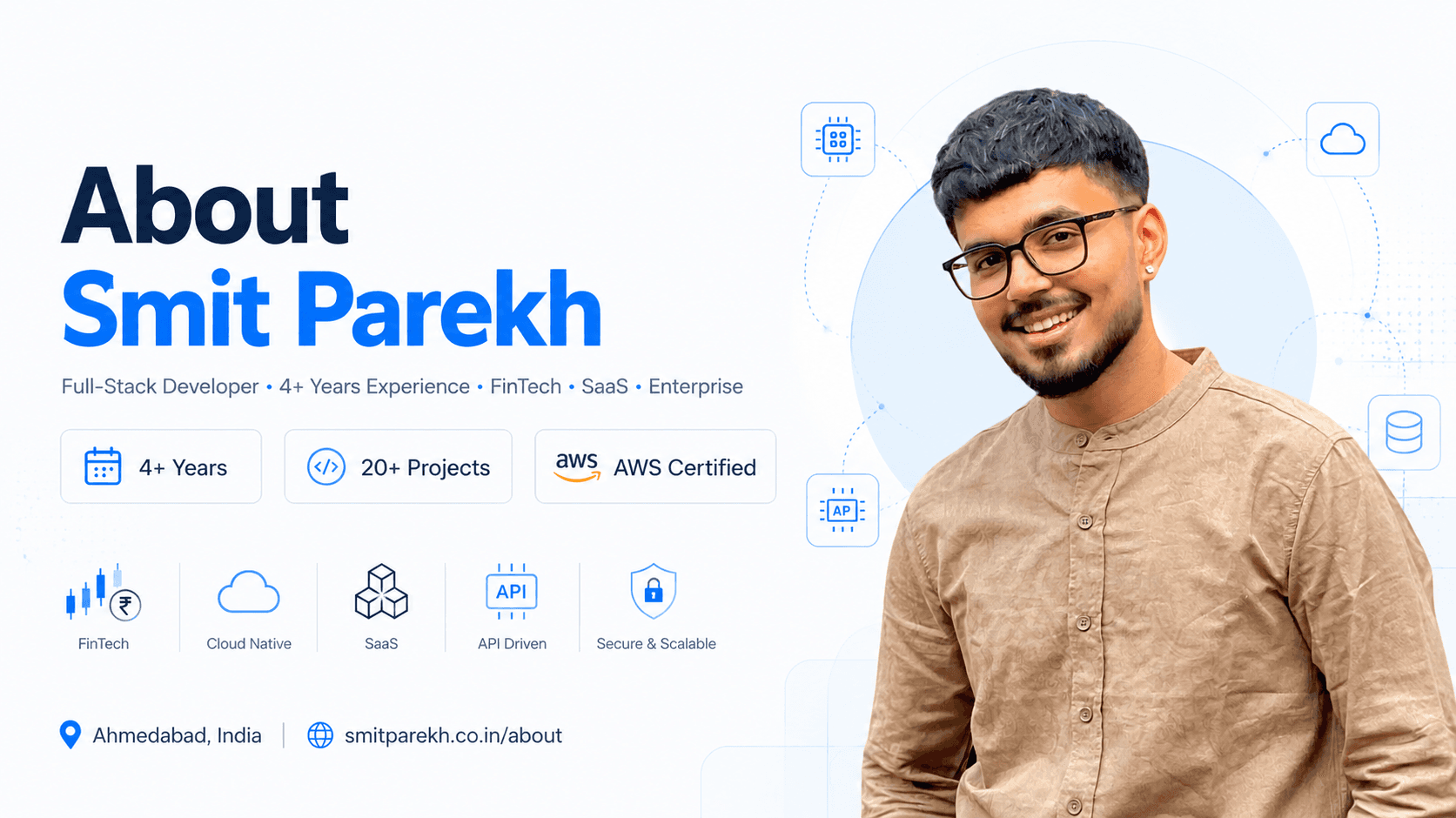
Smit Parekh
Full-Stack Developer
Gujarat, India · available worldwide
I'm the only person who touches your code. You talk directly to the senior developer writing every line - no account managers, no juniors, no handoffs. React, Next.js, Node.js, TypeScript and PostgreSQL, end to end.
- AWS Certified Solutions Architect
- 4+ years shipping production web apps
- 20+ live systems across FinTech, SaaS & AI
Everything included in every engagement
No upsells. No surprise change orders. One scope, one price.
Full-stack app with core user flows
Next.js frontend + Node.js API + PostgreSQL database. Typesafe end-to-end, mobile-responsive from day one, and fast enough to impress investors without a loader spinner.
Authentication & role-based access
Email/password, Google OAuth, or magic links via Supabase Auth or Clerk. User roles and permission guards included - you don't have to bolt them on post-launch.
Payments wired up
Stripe Checkout, subscriptions, and webhooks. Pricing page, trial logic, and a billing portal so users can manage themselves. PCI-compliant from the start.
Admin dashboard
Internal dashboard to manage users, view signups, toggle flags, and handle support tasks - without needing direct DB access. Saves hours every week from day one.
Production deploy + CI/CD
Vercel + Supabase (or Railway) with preview environments per branch and a GitHub Actions pipeline. You get a real URL for your pitch deck, not a localhost screenshot.
Handover documentation
Architecture overview, environment setup guide, and a Loom walkthrough of the codebase. Any developer you hire next can be productive in hours, not weeks.
Results that build trust
The numbers behind the work - measured on real production data, not demos.
20+
MVPs shipped to real users
4-8 wks
Average time from kickoff to live
Fixed
Price - no scope creep surprises
30 days
Post-launch bug-fix support
The tools I actually use in production
Modern, battle-tested, and chosen for fit - not hype.
Frontend
- Next.js 14+
- TypeScript
- Tailwind CSS
- shadcn/ui
Backend
- Node.js
- Express / Hono
- Zod
- Prisma ORM
Database & Auth
- PostgreSQL
- Supabase
- Clerk
- Redis
Payments & Deploy
- Stripe
- Vercel
- Railway
- GitHub Actions
How we'll work together
Predictable, written-down, no surprises.
- 01
Scope session (Day 1)
30-minute call to map the core user journey. We cut anything that doesn't prove the value prop. You get a written scope and fixed quote within 24 hours.
- 02
Schema & wireframes (Week 1)
Data model, API contracts, and page-level wireframes. Every decision written down before code starts. No re-architecture surprises mid-build.
- 03
Iterative build (Weeks 2-6)
Weekly deployed previews. Loom walkthroughs at each milestone. Feedback in the PR - nothing waits for a big reveal at the end.
- 04
Launch & handover (Week 7-8)
Final QA, Lighthouse audit, production deploy, and codebase walkthrough. 30 days of post-launch bug fixes included.
AWS Certified
Solutions Architect
I'm Smit Parekh - a full-stack developer who writes every single line of your code
With 4+ years of experience shipping production systems for FinTech, SaaS, and AI startups, I work as a senior individual contributor - no juniors on your project, no account managers between you and the work. Every commit, every architecture decision, every deployment lands on my machine first.
I specialise in the TypeScript ecosystem - React & Next.js on the frontend, Node.js / NestJS on the backend, PostgreSQL for data, and AWS for infrastructure. I've built headless e-commerce stores, multi-tenant SaaS platforms, real-time dashboards, AI-powered tools, and performance-first marketing sites. The common thread: clean code, zero tech-debt handover docs, and measurable business results.
10+ production apps shipped
FinTech, SaaS, AI startups & e-commerce
95+ Lighthouse scores, guaranteed
Performance baked in from day one
AWS Certified Solutions Architect
Infrastructure decisions you can trust
Direct, async-first communication
You talk to who writes every line of code
My daily stack
Pricing that matches the work
Starting prices. Final quote in writing after a 30-minute scoping call.
Lean MVP
Validate a single core loop
$3,500starting
- 1 user type, 3-5 core screens
- Auth + 1 payment flow
- Deployed to Vercel / Supabase
- Delivered in 2-3 weeks
Full MVP
Investor-ready, demo-able product
$7,500starting
- 2 user types (e.g. user + admin)
- Auth, payments, dashboard, onboarding
- 5-10 core flows, mobile responsive
- Delivered in 4-6 weeks
Post-launch Retainer
Iterate after first users
$2,000/mostarting
- Dedicated hours for new features
- Bug fixes + performance work
- Weekly async standups
- Cancel any time
Me vs. an agency vs. hiring in-house
Three ways to get this built. Here's the honest comparison.
Best value Solo Dev (me) $80-$120 /hr or fixed | Agency $150-$300 /hr blended | In-house hire $80-$120K /yr + benefits | |
|---|---|---|---|
| Start date | 1-2 weeks from quote | 4-8 weeks onboarding | 8-16 weeks to hire |
| Who writes the code | Senior dev - every single line | Junior assigned to your account | Whoever you manage to hire |
| Communication | Direct - you talk to who codes | Via account manager first | Direct, but management overhead |
| Flexibility | Scale up or down any time | Locked to contract length | Fixed headcount, hard to change |
| Code ownership | 100% yours, full handover docs | Depends on contract terms | Yours, but bus factor risk |
| Risk | Weekly demos, fixed scope | Scope creep & handoff gaps | Wrong hire = months lost |
Questions I get asked first
How is an MVP different from a full product?+
An MVP has exactly one core user journey - the thing that proves your value. Everything else (settings, reports, integrations, secondary flows) is cut. I help you decide what that core is, and we build only that. You can always add more after validation.
Can we add features after the MVP ships?+
Yes - most clients continue on a monthly retainer after launch to iterate based on real user feedback. The codebase is structured for extension from the start.
What if requirements change mid-build?+
Small changes are absorbed. Significant scope changes (new entities, new flows) are scoped separately and quoted. Nothing gets added silently - every change is a written decision.
Do you help with the product itself, or just the code?+
Both. Part of the discovery call is questioning the scope. If a feature adds complexity without adding proof, I'll flag it. Some of the best decisions I've made for clients were cuts, not additions.
Will the MVP be able to scale when I get users?+
Yes. I use PostgreSQL with proper indexes, a stateless API, and a Vercel/Railway deploy that autoscales. The architecture handles 10K+ daily active users without a rewrite.
Let's scope your project
Tell me what you're building. I'll reply with a written estimate within 24 hours - no sales call required.
Related services
Often paired with mvp development.
Web Development
From the database schema to the deployed Next.js frontend, I ship modern web apps designed to rank, convert, and scale. One engineer, full ownership.
SaaS Development
End-to-end SaaS builds with Stripe billing, multi-tenant auth, role-based access, onboarding flows, and admin dashboards - built to take real paying customers.
API Development
Well-versioned, well-documented REST or GraphQL APIs with auth, rate limiting, and webhooks. Built to be consumed by partners and customers - not only your own frontend.
Frontend Development
Production-grade React and Next.js frontends with a focus on accessibility, performance, and design systems. Built to scale across teams and devices.