Backends built for real production traffic
Typed Node.js and NestJS APIs with PostgreSQL or MongoDB, Redis caching, structured logs, and the boring discipline that keeps p95 latency under 100ms.
Most backends are fine on launch day. The question is what happens in month 6 - when traffic is 10× higher, the team has tripled, and the original developer has left. That's the backend I build.
<100ms
p95 latency target on production APIs
10K+
Daily API requests handled at 99.9% uptime
65%
Average query speedup on optimisations
0
Plaintext passwords ever stored
Trusted by founders & teams in

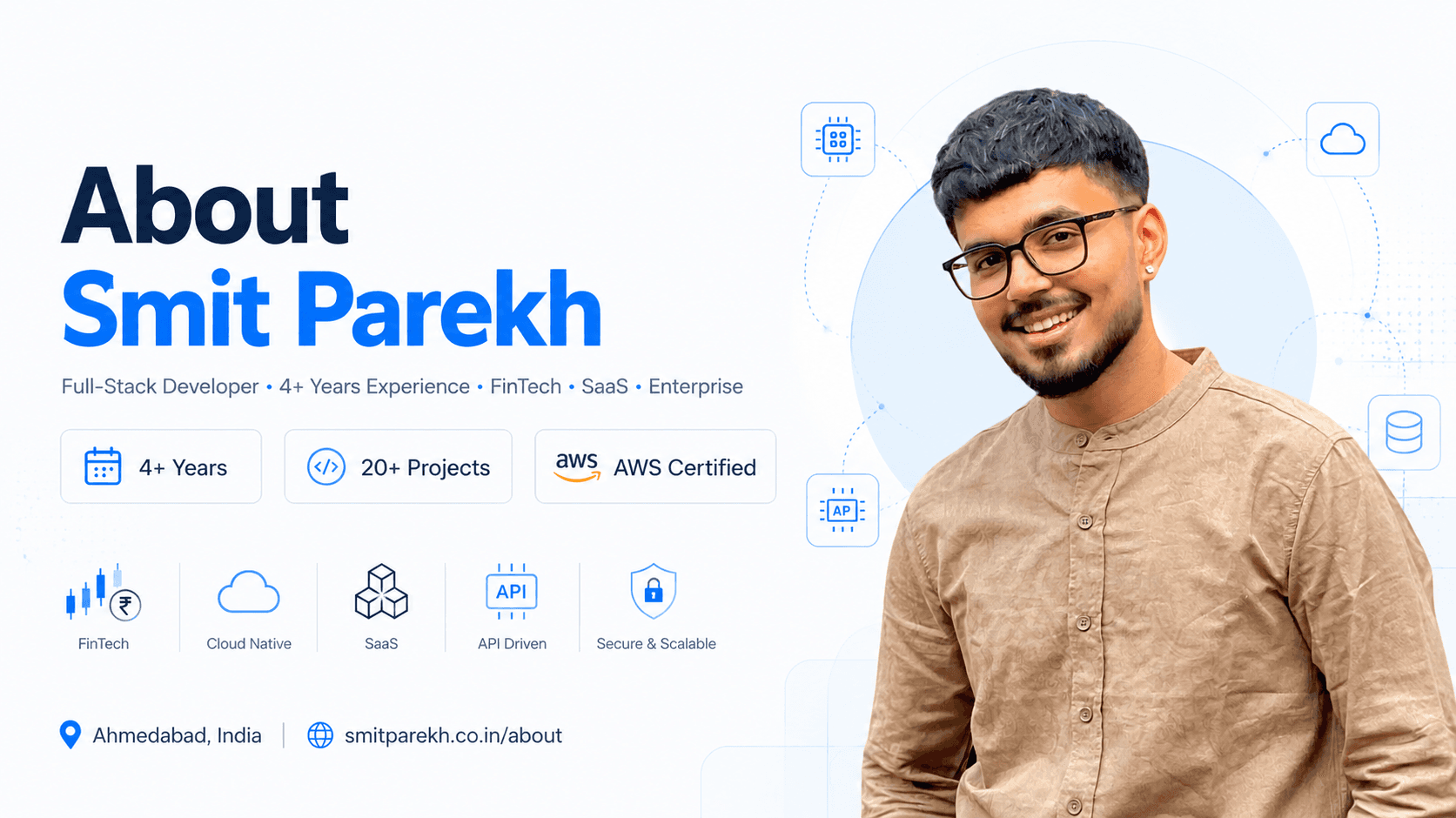
Smit Parekh
Full-Stack Developer
Gujarat, India · available worldwide
I'm the only person who touches your code. You talk directly to the senior developer writing every line - no account managers, no juniors, no handoffs. React, Next.js, Node.js, TypeScript and PostgreSQL, end to end.
- AWS Certified Solutions Architect
- 4+ years shipping production web apps
- 20+ live systems across FinTech, SaaS & AI
Everything included in every engagement
No upsells. No surprise change orders. One scope, one price.
Typed REST and GraphQL APIs
End-to-end TypeScript with Zod or class-validator at the boundary, OpenAPI docs, and consistent error handling. Every route is a contract you can lean on.
PostgreSQL & MongoDB done right
Schema design, indexing strategy, migrations, RLS for multi-tenancy, soft deletes, audit logs. Queries that stay sub-100ms past 1M rows.
Caching & rate limiting
Redis for hot data and rate limits, ETags for conditional requests, response compression, connection pooling. Throughput up, infra cost down.
Auth, authz, and security
JWT access + refresh, OAuth, RBAC, API keys, session rotation, OWASP-aware input handling. Done once, done right, audited.
Webhooks & background jobs
Reliable delivery with retry + DLQ, idempotent handlers, BullMQ or Cloud Tasks for async work, cron jobs that you can actually monitor.
Observability built in
Structured logs, request IDs end to end, OpenTelemetry traces, error tracking, and SLO dashboards. You see problems before users do.
Results that build trust
The numbers behind the work - measured on real production data, not demos.
<100ms
p95 latency target on production APIs
10K+
Daily API requests handled at 99.9% uptime
65%
Average query speedup on optimisations
0
Plaintext passwords ever stored
The tools I actually use in production
Modern, battle-tested, and chosen for fit - not hype.
Frameworks
- NestJS
- Express
- Fastify
- tRPC
Data
- PostgreSQL
- MongoDB
- Redis
- Prisma
Infra
- AWS
- Docker
- GitHub Actions
- Cloudflare
Quality
- Zod
- Jest
- Supertest
- OpenAPI
How we'll work together
Predictable, written-down, no surprises.
- 01
Architecture review
Map the data model, identify hot paths, surface scale risks. Output: a written architecture doc you can share with stakeholders.
- 02
Build & test
TDD-friendly module structure, contract tests against the OpenAPI schema, integration tests against a real DB - not mocks.
- 03
Load & harden
k6 load tests at projected scale, fix the slowest endpoints first, add caching where it actually moves the needle.
- 04
Ship & monitor
Blue/green or canary deploys, dashboards for p95 latency and error rate, on-call runbook for the team.
AWS Certified
Solutions Architect
I'm Smit Parekh - a full-stack developer who writes every single line of your code
With 4+ years of experience shipping production systems for FinTech, SaaS, and AI startups, I work as a senior individual contributor - no juniors on your project, no account managers between you and the work. Every commit, every architecture decision, every deployment lands on my machine first.
I specialise in the TypeScript ecosystem - React & Next.js on the frontend, Node.js / NestJS on the backend, PostgreSQL for data, and AWS for infrastructure. I've built headless e-commerce stores, multi-tenant SaaS platforms, real-time dashboards, AI-powered tools, and performance-first marketing sites. The common thread: clean code, zero tech-debt handover docs, and measurable business results.
10+ production apps shipped
FinTech, SaaS, AI startups & e-commerce
95+ Lighthouse scores, guaranteed
Performance baked in from day one
AWS Certified Solutions Architect
Infrastructure decisions you can trust
Direct, async-first communication
You talk to who writes every line of code
My daily stack
Pricing that matches the work
Starting prices. Final quote in writing after a 30-minute scoping call.
API Build
New product backends
$3,000starting
- 5-15 endpoints
- Auth, validation, OpenAPI docs
- Deployed to AWS or Render
- Delivered in 2-4 weeks
Scale
Teams hitting scale or rewriting
$7,500starting
- Multi-tenant, RBAC, audit logs
- Redis caching + rate limiting
- Load tested at projected scale
- Observability + runbooks
Retainer
Ongoing backend work
$2,500/mostarting
- New endpoints, schema evolution
- Performance regression watch
- On-call rotation support
Me vs. an agency vs. hiring in-house
Three ways to get this built. Here's the honest comparison.
Best value Solo Dev (me) $80-$120 /hr or fixed | Agency $150-$300 /hr blended | In-house hire $80-$120K /yr + benefits | |
|---|---|---|---|
| Start date | 1-2 weeks from quote | 4-8 weeks onboarding | 8-16 weeks to hire |
| Who writes the code | Senior dev - every single line | Junior assigned to your account | Whoever you manage to hire |
| Communication | Direct - you talk to who codes | Via account manager first | Direct, but management overhead |
| Flexibility | Scale up or down any time | Locked to contract length | Fixed headcount, hard to change |
| Code ownership | 100% yours, full handover docs | Depends on contract terms | Yours, but bus factor risk |
| Risk | Weekly demos, fixed scope | Scope creep & handoff gaps | Wrong hire = months lost |
Questions I get asked first
Do you work with NestJS specifically, or general Node?+
Both. NestJS is my default for anything past a basic CRUD because of dependency injection and guards/interceptors. Express or Fastify when minimalism matters more.
Can you take over a struggling backend?+
Yes - I do this often. The first deliverable is a written audit covering perf hotspots, security risks, and a prioritised remediation plan before any code is touched.
Do you handle background jobs and queues?+
Yes. BullMQ with Redis, Cloud Tasks, or AWS SQS - picked based on your infra. Always idempotent handlers and a dead-letter strategy.
What about migrations and zero-downtime deploys?+
Migrations are versioned with Prisma or knex/squitch, applied in a separate step from app deploy. Schema changes use expand-then-contract so writes never break.
Let's scope your project
Tell me what you're building. I'll reply with a written estimate within 24 hours - no sales call required.
Related services
Often paired with backend development.
API Development
Well-versioned, well-documented REST or GraphQL APIs with auth, rate limiting, and webhooks. Built to be consumed by partners and customers - not only your own frontend.
Web Development
From the database schema to the deployed Next.js frontend, I ship modern web apps designed to rank, convert, and scale. One engineer, full ownership.
SaaS Development
End-to-end SaaS builds with Stripe billing, multi-tenant auth, role-based access, onboarding flows, and admin dashboards - built to take real paying customers.
AI Integration
OpenAI, Anthropic Claude, and open-source LLMs wired into your app with RAG, structured outputs, evals, and the discipline that keeps it cheap and reliable at scale.